

Title:BEAUTREO (Japanese: ザ・ビューレック / THE BEAUTREO)
Issue / Date: No. 521, August 2023
Main Title: Crisis Management in Salons~ Creating a Safe Environment ~
Circular Logo Text: Collector’s Edition
English Title:CRISIS MANAGEMENT (meaning “crisis management”)
Title: Crisis Management in the Salon ~Creating a Safe Environment~
(Top Right Logo) UNIVERSAL BEAUTY (meaning “Universal Beauty”)
Recently, the number of people with allergies has been increasing, leading to a rise in cosmetics-related issues. At the same time, as aging progresses, accidents in beauty salons are also on the rise.
When an unexpected situation occurs, taking prompt response measures to minimize damage and maintain business continuity is the core principle of crisis management. According to the “Survey on the Current State of Crisis Management in Japanese Companies,” the top three “domestic risks that should be prioritized” are “extreme weather and natural disasters,” “labor environment issues or sharp rises in raw material prices,” and “information leaks and cyberattacks,” indicating that companies’ crisis awareness has extended to these areas.
First, in healthcare-related industries, recent years have seen not only a reevaluation of products such as cosmetics due to the increasing number of people with allergies, but also greater vigilance regarding incidents such as oral accidents caused by aging. Moreover, consumers are no longer focused solely on the “external” aspects of the body, but are also paying more attention to “internal” health. In addition, as the boundaries between medical care and beauty become blurred and barriers to entry in the beauty industry are lowered, a large number of new devices have entered the market. Against this backdrop, accidents related to treatments such as HIFU (High-Intensity Focused Ultrasound), hair removal, and self-administered beauty care have emerged. Today, the beauty industry is developing systems to support the healthy growth of the entire industry. These efforts aim to create a safe environment where customers can enjoy beauty services with peace of mind by disseminating accurate knowledge that goes beyond traditional beauty concepts and cracking down on illegal devices.
On the other hand, as compliance requirements become stricter and society becomes increasingly intolerant of even minor mistakes, workplace team dynamics are becoming more complex. Recently, dissatisfied customers are less likely to provide direct feedback about products or services, and instead are increasingly engaging in “silent complaints” by posting their grievances on social media.
With the Anti-Harassment Law set to take effect in October, salons must not only address workplace harassment issues, but also need to review and share clear rules on social media usage.
This year marks the 100th anniversary of the Great Kanto Earthquake, which occurred on September 1. In this special feature, we focus on “fire prevention measures in salons” and explore how to enhance safety in the workplace.
Crisis Management in Beauty Salons
Prevent Risks Before They Happen
For beauty salons that come into direct contact with customers’ hair and skin, it is no exaggeration to call crisis management a top priority.
So, what kind of preparations can salons make? The following article introduces industry initiatives aimed at preventing problems before they occur.
Why is crisis management necessary?
When an accident occurs, the salon suffers the most damage.
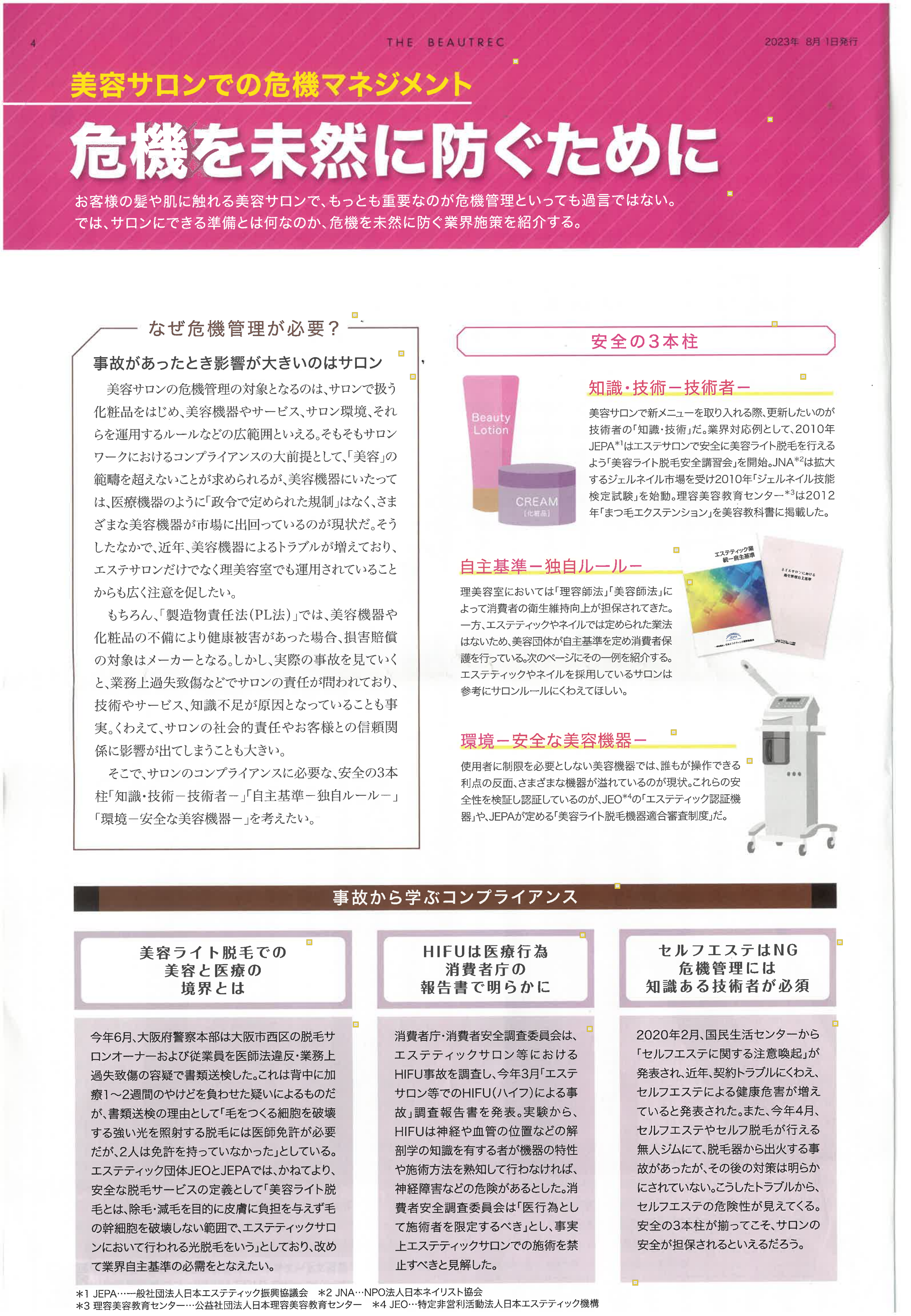
The scope of risk management in beauty salons is broad, encompassing not only the cosmetics used but also beauty equipment, service procedures, the salon environment, and the staff who operate these tools. All of these form the compliance foundation for a salon’s business operations, and they must also stay within the boundaries of “beauty services.” However, unlike medical devices, beauty equipment is not subject to clear regulations established by administrative authorities, and a large number of such devices continue to circulate in the market. As a result, disputes caused by beauty equipment have been on the rise in recent years. Moreover, these instruments are not only used in beauty salons but have also found their way into barbershops and other establishments—a trend that requires extra attention.
In addition, under the Product Liability Act (PL Act) , if health damage is caused by defects in beauty equipment or cosmetics, the manufacturer is liable for compensation. However, looking at actual accidents, it is common for salons to be held responsible for professional negligence resulting in injury, and insufficient skills or knowledge among staff is often one of the real causes. Moreover, such accidents can have a significant impact on a salon’s social responsibility image and customer trust.
Therefore, let us consider the three pillars of safety required for a salon’s compliant operation: “Knowledge and Skills – The Technicians,” “Voluntary Standards – Independent Rules,” and “Environment – Safe Beauty Equipment.”
The three pillars of safety
①Knowledge & Skills — Technicians —
When beauty salons introduce or update new services, the key lies in the knowledge and skills of their technical staff. As examples of industry responses, in 2010 the Japan Estheticians and Beauty Advisors Association (JEPA) launched the “Beauty Laser Hair Removal Safety Seminar” to guide salons in safely performing laser hair removal treatments. In the same year, the Japan Nailist Association (JNA) introduced the “Eyelash Extension Skills Certification Exam” in response to the rapidly expanding eyelash extension market. In 2012, the Beauty and Barber Education Center included “compliance management” in its beauty textbooks.
②Voluntary Standards — Independent Rules —
In hair and beauty salons, the “Barber Act” and “Beauty Salon Act” play a crucial role in ensuring and improving hygiene standards for consumers. However, in the nail and eyelash extension sectors, there are currently no corresponding industry regulations. As a result, beauty industry organizations have established voluntary standards to protect consumers. The next section will introduce one such case. Salons that offer nail or eyelash extension services are advised to refer to these standards when formulating their own internal rules.
③Environment — Safety of Beauty Equipment —
For beauty equipment that does not require restricted use, while the advantage is that “anyone can operate it,” the current reality is that a large number of non-compliant devices flood the market. The organizations responsible for testing and certifying the safety of such equipment are the “Nail Certification Devices” recognized by Japan’s Ministry of Economy, Trade and Industry (METI), and the “Beauty Laser Hair Removal Equipment Compliance Review System” established by the Japan Estheticians and Beauty Advisors Association (JEPA).
Key Lessons Learned from Accidents
①Laser Hair Removal: The Line Between Aesthetic and Medical Treatment
Last June, the Osaka Prefectural Police Headquarters sent the operator of a hair removal salon in Nish Ward, Osaka, to the public prosecutor’s office on suspicion of violating the Medical Practitioners Act and causing injury through professional negligence. The case involved the salon offering treatments such as “spot removal” and “whitening,” in addition to hair removal procedures that use high‑intensity lasers capable of destroying hair follicles—treatments that legally require a medical license, which the operator did not possess.
②HIFU falls under medical practice, as clearly specified in the consumer-side report.
The Consumer Affairs Agency (Consumer Safety Investigation Commission) conducted an investigation into HIFU accidents occurring at nail salons and similar establishments, and in March of this year released the “Investigation Report on HIFU (High-Intensity Focused Ultrasound) Accidents at Nail Salons and Other Facilities.” Case studies show that HIFU has the characteristic of “being able to target specific areas such as blood vessels,” and if the operator is not familiar with the locations of nerves and blood vessels or the proper treatment methods, there is a risk of causing nerve damage. The Commission concluded that HIFU “should be classified as a medical practice and that practitioner qualifications should be restricted,” and advocated for an effective ban on such procedures being performed at nail salons.
③Self-service nail services are not recommended, as professional technicians are essential for effective crisis management.
In February 2020, the National Consumer Affairs Center of Japan issued a “Safety Warning on Self-Service Nail Salons,” pointing out that such services pose risks such as skin injuries, and that related health hazards have been increasing in recent years. In addition, in April of this year, an accident occurred where a hair removal device suddenly caught fire next to an unattended self-service nail and hair removal station, and the subsequent response measures remain unclear.
These incidents demonstrate that self-service nail services involve three major risks — none of the three pillars of safety (knowledge and skills, voluntary standards, and environment) are adequately ensured.
*1 JEPA: Japan Esthetics Promotion Association (General Incorporated Association)
*2 JNA — Specified Nonprofit Corporation Japan Nailist Association
*3 Beauty and Barber Education Center: Public Interest Incorporated Foundation Japan Beauty and Barber Education Center
*4 JEO: Japan Esthetics Organization (Specified Nonprofit Corporation)
Selecting Nail Equipment: Key Considerations
「Safety: Certification of Nail Equipment That Has Passed Testing」
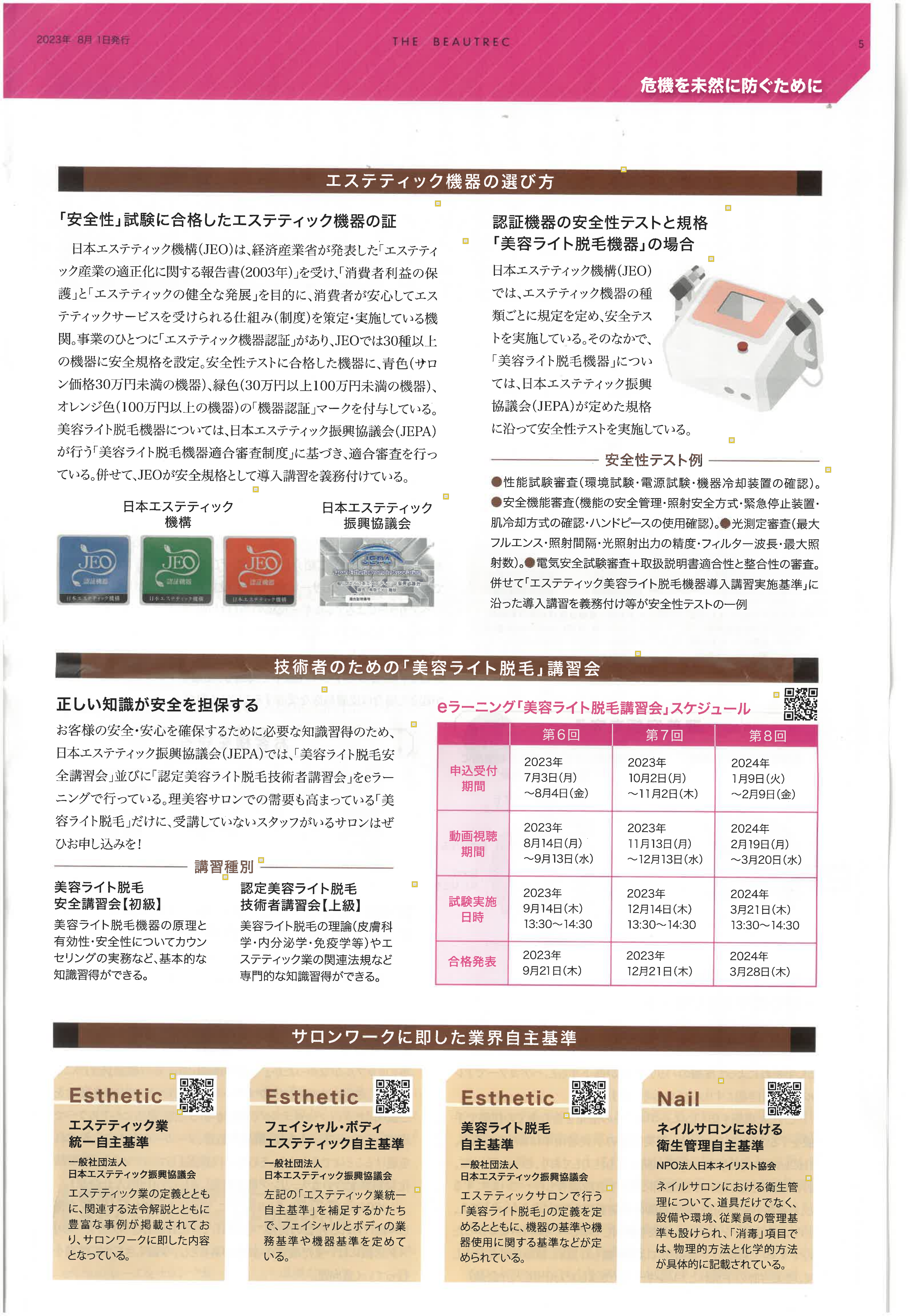
The Japan Esthetics Organization (JEO) is an entity established based on the Ministry of Economy, Trade and Industry’s (METI) “Report on the Standardization of the Nail Industry” (2003). With the goals of “protecting consumer rights” and “promoting the sound development of the nail industry,” JEO is developing and implementing systems to ensure that “consumers can enjoy nail services with peace of mind.”
One of JEO’s key initiatives is its “Nail Equipment Certification” program. The organization has established safety standards for more than 30 types of nail equipment. For devices that pass safety testing, JEO affixes labels based on sales price: blue for products under 300,000 yen, green for those between 300,000 and 1,000,000 yen, and orange for items over 1,000,000 yen.
Safety Testing and Specifications for Certified Equipment — The Case of Beauty Laser Hair Removal Devices
The Japan Esthetics Organization (JEO) first formulates the relevant standards for beauty laser hair removal equipment before conducting safety testing. However, in practice, the safety testing is currently carried out by the Japan Esthetics Promotion Association (JEPA) in accordance with the specifications established by JEO.
Examples of Safety Testing:
Performance Testing and Investigation: environmental testing, electrical current testing, and verification of the machine’s cooling system.
Safety Function Investigation (Functional Safety Management): verification of irradiation safety methods, emergency stop devices, and skin cooling methods; and confirmation of the proper use of hand‑held components.
Light Measurement Investigation: measurement of maximum output, irradiation interval, accuracy of light output, filter wavelength, and maximum number of irradiations.
Electrical Safety Test Investigation: review of compatibility and consistency with the instruction manual.
Additionally, “conducting instructor training in accordance with the ‘Implementation Standards for Instructor Training on Nail and Beauty Laser Hair Removal Machines’” is also considered an example of safety testing.
Professional Workshop on Beauty Laser Hair Removal for Technicians
Correct knowledge is the guarantee of safety.
To ensure customers' safety and peace of mind, the Japan Esthetics Promotion Association (JEPA) is conducting both offline and online training sessions, including the "Beauty Laser Hair Removal Safety Workshop" and the "Certified Beauty Laser Hair Removal Technician Workshop." Even if your beauty salon does not currently offer the "beauty laser hair removal" service—for which demand is soaring—it is recommended that you register for these workshops in advance to prepare adequately!
Types of Workshops:
①Beauty Laser Hair Removal Safety Workshop [Beginner Level]: You can learn about the principles of beauty laser hair removal equipment, knowledge related to effectiveness/safety, as well as basic practical knowledge.
②Certified Beauty Laser Hair Removal Technician Workshop [Advanced Level]: Participants can learn professional knowledge such as theories of beauty laser hair removal (dermatology, endocrinology, immunology, etc.) and laws and regulations related to the nail industry.
Online Training: “Beauty Laser Hair Removal Workshop” — Beginner Course
6th Session | 7th Session | 8th Session | |
Registration Period | July 3 (Mon) – August 4 (Fri), 2023 | October 2 (Mon) – November 2 (Thu), 2023 | January 9 (Tue) – February 9 (Fri), 2024 |
Video Viewing Period | August 14 (Mon) – September 13 (Wed), 2023 | November 13 (Mon) – December 13 (Wed), 2023 | February 19 (Mon) – March 20 (Wed), 2024 |
Examination Period | September 14 (Thu), 2023, 13:30 – 14:30 | December 14 (Thu), 2023, 13:30 – 14:30 | March 21 (Thu), 2024, 13:30 – 14:30 |
Announcement of Results | September 21 (Thu), 2023 | December 21 (Thu), 2023 | March 28 (Thu), 2024 |
Industry Self-Regulatory Standards Tailored to Salon Operations
①Esthetic(美容)
Unified Self-Regulatory Standards for the Beauty Industry
General Incorporated Association
Japan Beauty Promotion Association
This standard clearly defines the beauty industry, includes interpretations of relevant laws and regulations, and features a wealth of case studies, making it highly applicable to real‑world salon operations.
②Esthetic(美容)
Self-Regulatory Standards for Beauty & Body Care
General Incorporated Association
Japan Beauty Promotion Association
This standard serves as a supplement to the aforementioned “Unified Self-Regulatory Standards for the Beauty Industry,” and specifically establishes criteria related to beauty and body care services as well as the use of equipment.
③Esthetic(美容)
Beauty Laser Hair Removal Self-Regulatory Standards
General Incorporated Association
Japan Beauty Promotion Association
This standard clearly defines the “beauty laser hair removal” service provided in beauty salons, and also establishes standards for the equipment used in such services as well as guidelines for its operation.
④Nail(美甲)
Self-Regulatory Standards for Hygiene Management in Nail Salons
Japan Nailist Association (NPO Corporation)
This standard regulates hygiene management in nail salons, establishing criteria not only for tools but also for equipment, the salon environment, and staff. In the section on “disinfection,” it details both physical and chemical methods.
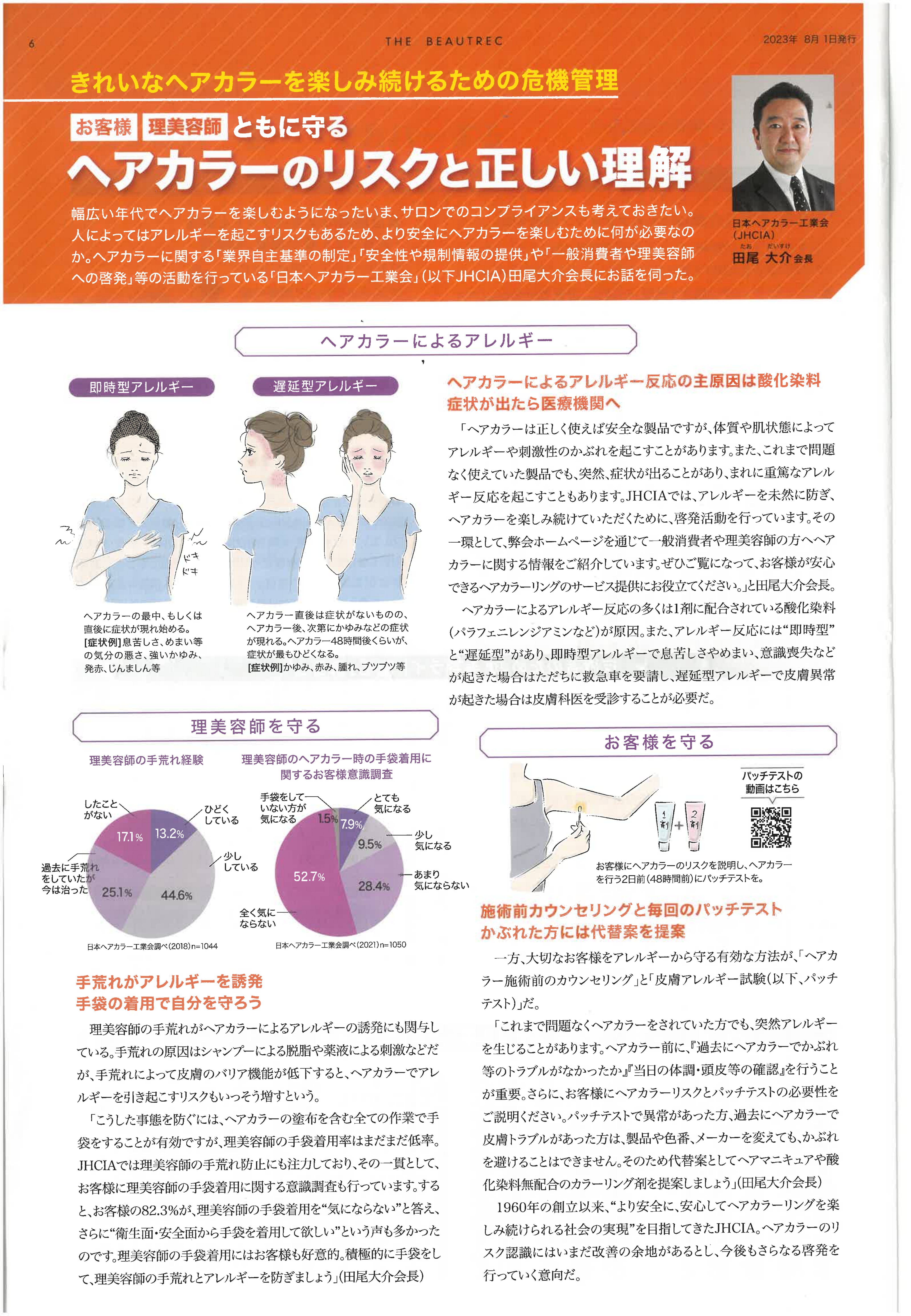
Crisis Management for Safe Enjoyment of Hairdressing Services
Guests and Beauty Therapists: Jointly Safeguard
Risks of Hairdressing Services and Proper Understanding
I hope to continue enjoying hair care even in my senior years, and I’m also thinking about how to support the needs of older clients. However, different people may face allergy risks. What should we do to enjoy hair care more safely?
Regarding hair care, the Japan Hair Care & Longevity Association (JHCLA) is promoting initiatives such as developing industry self-regulatory standards, providing information on safety regulations, and raising awareness among general consumers and beauty professionals. We interviewed Daisuke Tao, the president of JHCLA, to learn more.
Allergies Caused by Hair Care Treatments
Immediate‑type Allergy
Be mindful of any reactions during or right after the hair care treatment.
【Examples of Symptoms】Difficulty breathing, itching or other physical discomfort, intense burning, redness, swelling, etc.
Delayed‑type Allergy
There may be no symptoms immediately after a hair care treatment, but itching and other reactions can appear gradually afterward. Typically, symptoms become most severe about 48 hours after the treatment.
【Examples of Symptoms】Itching, redness, swelling, blisters, etc.
Protecting Beauty Professionals
The experience of dry, cracked hands among beauty professionals
Customer Awareness Survey on Beauty Professionals Wearing Gloves During Hair Care Treatments
Dry and cracked hands may induce allergic reactions, making it important for beauty professionals to protect themselves by wearing gloves.
Dry, cracked hands among beauty professionals are linked to allergies caused by hair care treatments. Dryness and cracking can result from degreasing by shampoos, irritation from chemicals, and other factors. When the skin’s barrier function is compromised, the risk of developing allergies during hair care may increase.
“To prevent these issues, wearing gloves during all procedures—including hair coloring—is effective. However, the current rate of glove use among beauty professionals remains low. The Japan Hair Care & Cosmetics Industry Association is also focusing on preventing dry, cracked hands among beauty professionals, and as part of this effort, we conducted a survey on customer awareness regarding beauty professionals wearing gloves. The results showed that 82.3% of customers said they ‘do not mind’ beauty professionals wearing gloves, and many also commented that they ‘hope professionals wear gloves from a hygiene and safety perspective.’ This indicates that customers have a favorable view of beauty professionals wearing gloves. Therefore, please make an effort to wear gloves actively to prevent dry, cracked hands and allergies.”
— Daisuke Tao, President
The main cause of allergic reactions from hair care treatments is acid dyes. If symptoms appear, it is important to visit a medical institution.
“Hair care products are safe when used correctly, but they can still cause allergies or irritation depending on a person’s constitution or skin condition. What’s more, even products that have been used without issues in the past can suddenly cause symptoms, and in some cases, even severe allergic reactions. To help prevent allergies and allow everyone to enjoy hair care services with peace of mind, the Japan Hair Care & Cosmetics Industry Association is conducting educational initiatives. As part of this effort, we provide information about hair care to both consumers and beauty professionals through our website. We hope this information will be useful and help support the provision of safe and reassuring hair care services.”
— Daisuke Tao, President
Most allergic reactions caused by hair care treatments are triggered by acid dyes—such as paraphenylenediamine (PPD) compounds—added to the first agent. Allergic reactions are broadly divided into two types: immediate and delayed. In cases of immediate allergic reactions, if symptoms such as difficulty breathing, hives, or loss of consciousness occur, an ambulance should be called immediately. For delayed allergic reactions, if any skin abnormalities appear, it is necessary to visit a dermatologist.
Protecting Customers
Explain the risks of hair care treatments to customers and conduct a patch test 2 days (48 hours) prior to the hair care service.
For customers who are unable to undergo a pre-treatment consultation or a patch test each time, alternative options should be offered.
On the one hand, effective ways to protect valued customers from allergies include conducting a “pre-treatment consultation” and performing a “skin allergy test (hereinafter referred to as a patch test).”
“Even customers who have never had problems with hair treatments before can suddenly develop an allergy. Before providing hair care, it is very important to confirm whether they have had any past issues related to hair services, as well as their physical condition and scalp condition on the day. In addition, please explain the risks of hair treatments and the necessity of patch tests to your customers. If a patch test shows any abnormalities, or if the customer has experienced skin problems from hair treatments in the past, changing the product, shade, or brand will not eliminate the risk. Therefore, it is recommended to offer alternative hair care options, such as hair conditioning treatments or hair coloring products that do not contain acid dyes.”
— Daisuke Tao, President
Since its establishment in 1960, JHcia (the Japan Hair Care & Cosmetics Industry Association) has been working toward creating a society where people can continue to enjoy hair care services safely and with peace of mind. The association states that there is still room for improvement in public awareness of hair care risks and intends to continue its educational initiatives in the future.
Crisis Management During Evacuation
“Beauty salon stroke syndrome”
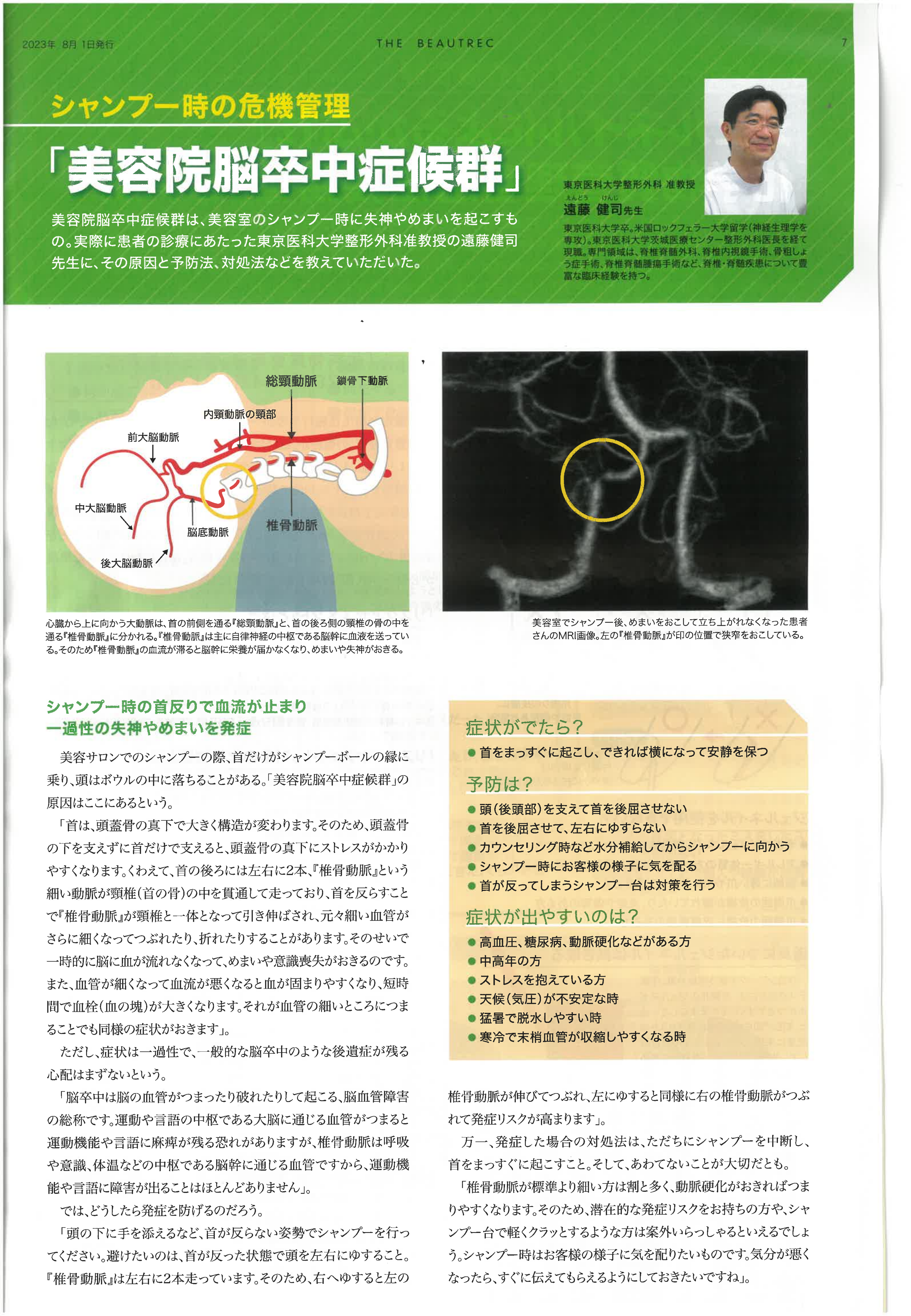
“Beauty salon stroke syndrome” refers to symptoms such as fainting or confusion that can occur when a person’s head is tilted backward for an extended period during hair washing or other procedures at a beauty salon. Dr. Masashi Endo, Associate Professor in the Department of Orthopedic Surgery at Tokyo Medical University, who has previously treated patients with this condition, will explain its causes, prevention, and appropriate response.
Figure 1:The large artery extending upward from the heart branches into the “common carotid artery,” which runs along the front of the neck, and the “vertebral artery,” which passes through the spaces between the cervical vertebrae at the back of the neck. The vertebral artery is responsible for supplying blood to the brainstem, the center of the autonomic nervous system. If the blood flow through the vertebral artery becomes blocked, the brainstem cannot receive sufficient oxygen and nutrients, which may lead to symptoms such as confusion or fainting.
Figure 2:This is an MRI image of a patient who experienced confusion and was unable to stand up after having their hair washed at a beauty salon. The image shows that the left vertebral artery is narrowed at the marked location.
Tilting the head backward during hair washing can interrupt blood flow, leading to temporary fainting or confusion.
During hair washing at beauty salons, there are cases where only the head is resting on the edge of the sink and the head is hanging down into the basin. This is considered one of the triggers for “beauty salon stroke syndrome.”
The structure of the neck directly beneath the skull changes significantly, so if the head is not supported just below the skull and the neck is left to support it alone, pressure can easily build up in that area. In addition, there is a thin artery on each side of the back of the neck called the “vertebral artery,” which runs through the gaps in the cervical vertebrae (the bones of the neck). When the head is tilted backward, the vertebral arteries stretch along with the cervical spine; because they are already thin, they may become even narrower, compressed, or even bent. This can temporarily reduce blood flow to the brain, leading to symptoms such as confusion or loss of consciousness. Furthermore, when blood vessels narrow and blood flow worsens, blood is more likely to clot, and a thrombus (blood clot) can grow larger in a short time. Even if the clot simply becomes lodged in a narrowed part of the vessel, it can trigger the same symptoms.
However, these symptoms are temporary, and there is usually no need to worry about long‑term sequelae like those seen in a typical stroke.
Stroke is a general term for cerebrovascular disorders caused by blocked or ruptured blood vessels in the brain. If a blood vessel connected to the cerebrum—the center responsible for movement and language—becomes blocked, it may lead to long-term motor or speech impairments. However, the vertebral arteries supply the brainstem, which controls functions such as breathing, consciousness, and body temperature, so symptoms typically do not include motor or speech disorders.
So how can we prevent it from happening?
Wash the hair in a position that does not involve tilting the neck backward, such as by supporting the head from below with your hand. What should be avoided is rotating the head from side to side while the neck is tilted backward. Since there is one vertebral artery on each side of the neck, turning the head to the right stretches and compresses the left vertebral artery, and turning it to the left compresses the right vertebral artery, increasing the risk of symptoms.
If symptoms should occur, the immediate response is to stop the hair washing right away. Do not suddenly lift the neck; remaining calm is the most important thing.
A significant number of people have a vertebral artery that is naturally narrower than average, and if there is also arteriosclerosis, problems are more likely to occur. Therefore, it is advisable for individuals at potential risk, as well as those who wish to “relax” while having their hair washed at the sink, to avoid this head‑tilted position. When washing a client’s hair, always pay attention to their condition and ensure they feel comfortable enough to speak up immediately if they feel unwell.
If symptoms do appear, what should you do?
Do not suddenly lift the neck. Instead, have the person lie down as much as possible and rest quietly.
What are the preventive measures?
Support the back of the head so that the neck does not tilt backward.
Do not turn the head from side to side while the neck is tilted backward.
Have the client hydrate (e.g., after treatments) before washing their hair.
Pay attention to the client’s condition during hair washing.
Take measures for hair-washing sinks that cause the neck to tilt backward.
Who is more likely to experience symptoms?
People with hypertension, diabetes, arteriosclerosis, or other such conditions
Middle-aged and older individuals
People under stress
During periods of unstable weather (barometric pressure changes)
During extreme heat, when dehydration is more likely
During cold weather, when peripheral blood vessels tend to constrict
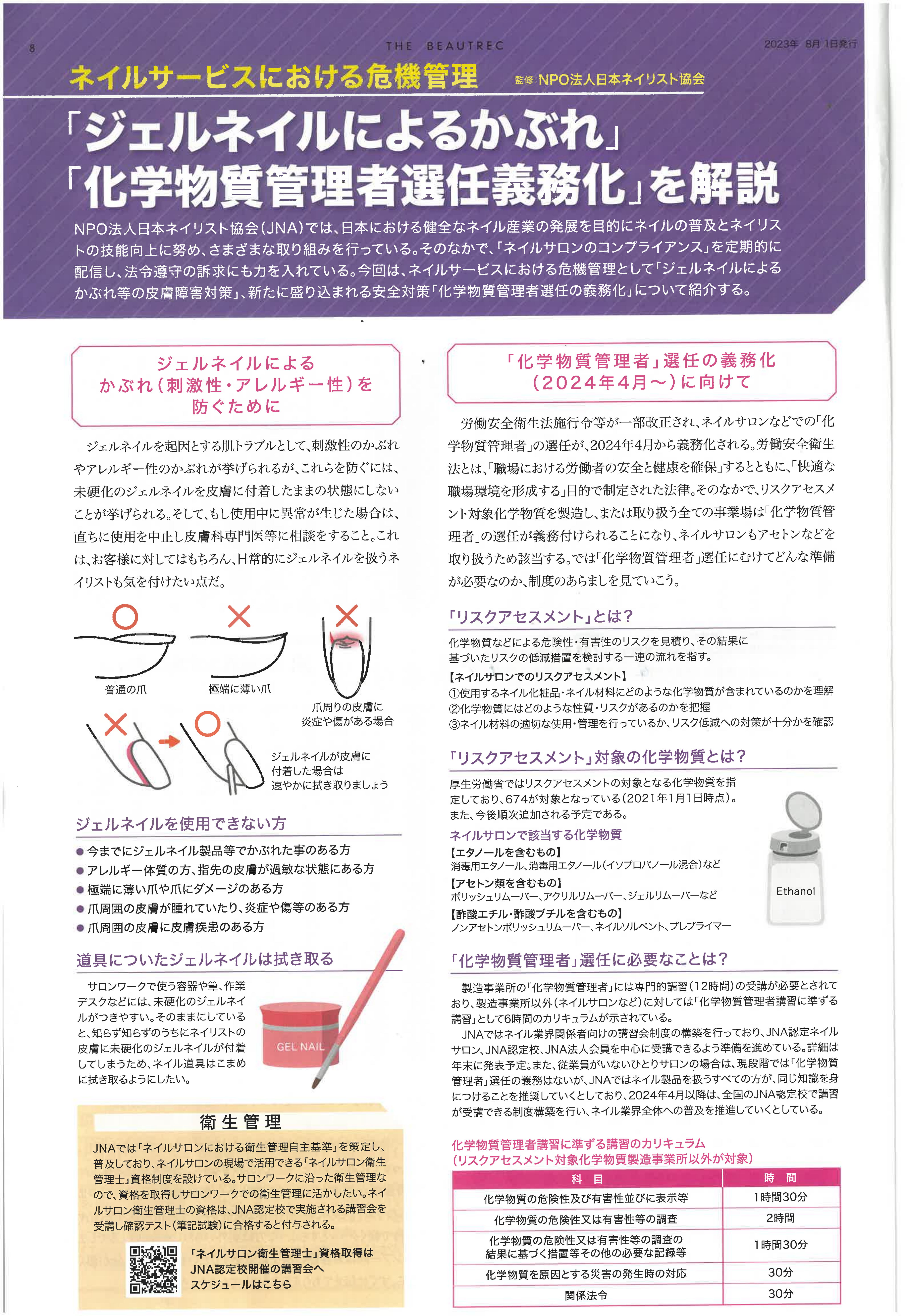
Crisis Management in Nail Care Services | Under the Supervision of the NPO Japan Nailist Association
Burns Caused by UV/LED Nail Lamp Exposure
An Explanation of the Legal Obligation to Appoint a Chemical Substance Manager
The NPO Japan Nailist Association (JNA) aims to promote the development of a safe nail care industry in Japan. It is committed to popularizing nail care and improving the skills of nail technicians, while actively conducting related activities.
To this end, the Association regularly issues the Code of Conduct for Nail Salons, incorporating legal and regulatory compliance requirements.
This time, we will introduce crisis management in the nail care industry, including “measures to address skin damage such as allergies caused by resin-based nail products,” as well as the newly introduced safety measure “strengthening the responsibilities of the Chemical Substance Manager.”
To prevent itching (irritant or allergic) caused by resin-based nail products
Skin problems caused by resin-based nail products can include irritant itching or allergic itching. To prevent these issues, please keep the following in mind: never use uncured resin products, and do not use them while the resin is still in contact with the skin. In addition, always take proper precautions when using various tools. Furthermore, be careful not only when working on clients, but also when doing your own nails in daily life.
People Who Are Not Advised to Use Resin-Based Nail Products
● People who are currently experiencing itching symptoms due to resin‑based nail products
● People who have severe skin allergies to resin‑based nail products or related solvents
● People with cuts or damage to the skin around the nails
● People whose skin around the nails is swollen, inflamed, or in an irritated condition
● People with skin conditions affecting the skin around the nails
Wipe off and clean resin‑based nail products from tools after use.
If uncured resin-based nail products remain on gauze, containers, work surfaces, or other items, or if cured resin that is known to cause skin problems for nail technicians adheres to tools, be sure to wipe and clean them thoroughly.
Health Management
JNA has established the “Self-Regulatory Standards for Nail Salon Hygiene Management”, which specify the key hygiene management points that nail salons must implement in their daily operations, including requirements for tools/equipment and systems/procedures.
Individuals holding the “Nail Salon Hygiene Manager” qualification are responsible for promoting and overseeing hygiene management in salons. All Nail Salon Hygiene Managers must complete training seminars designated by JNA and pass the corresponding skills assessment in order to obtain the qualification.
【Nail Salon Hygiene Manager: Qualification Acquisition Process】
JNA-designated Skills Training Seminar
Attend the training → Pass the skills test → Obtain the qualification
Mandatory Appointment of Chemical Substance Managers (Effective April 2024)
With the partial revision of the Ordinance for Enforcement of the Industrial Safety and Health Act, the appointment of Chemical Substance Managers will become mandatory in workplaces such as nail salons starting April 2024.
The Industrial Safety and Health Act is a law enacted to protect the safety and health of workers and to create a sound working environment. Therefore, all workplaces that produce or handle chemical substances subject to risk assessment are required to appoint a Chemical Substance Manager, and nail salons fall under this scope of application.
It is therefore necessary to prepare in advance for the appointment of a Chemical Substance Manager. Below is an overview of the specific requirements under the system.
“What is ‘risk assessment’?”
It refers to identifying and analyzing the risks of hazards and harmful effects posed by chemical substances, and promoting risk control measures for those substances based on the results.
【Risk Assessment in Nail Salons】
①Understand which chemical substances are contained in the nail cosmetics and nail materials used.
②Understand the properties and risks of each chemical substance.
③Verify whether the nail materials are being used and managed properly, and whether the risk‑reduction measures are adequate.
“What does ‘chemical substances subject to risk assessment’ refer to?”
The Ministry of Health, Labour and Welfare has designated certain chemical substances as subject to risk assessment. As of January 1, 2021, there were 674 such substances. In addition, it is planned to gradually increase the number of these substances in the future.
Chemical substances applicable to nail salons
【Substances containing ethanol】
Ethanol for disinfection, ethanol‑isopropanol mixtures for disinfection, etc.
【Substances containing acetone】
Polyethylene glue, acrylic glue, resin glue, etc.
【Substances containing ethyl acetate or butyl acetate】
Ethylene‑vinyl acetate (EVA)‑based polyethylene glues, nail lacquers, and plastic glues
What is required to appoint a “Chemical Substance Manager”?
In manufacturing factories, the Chemical Substance Manager is required to complete a 12‑hour professional training course. For workplaces other than manufacturing factories (such as nail salons), the requirement is to complete a 6‑hour “Chemical Substance Manager Preparatory Training” course.
JNA is developing a training system for nail industry professionals. Preparations are currently underway for participation primarily by JNA‑certified nail salons, JNA‑certified schools, and JNA corporate members, with detailed information expected to be announced by the end of the year.Additionally, for individual salons with no employees, there is currently no obligation to appoint a Chemical Substance Manager. However, JNA recommends that all nail technicians acquire the relevant knowledge. Starting April 2024, JNA will establish a system allowing training to be taken at JNA‑certified schools nationwide, helping to disseminate and promote this knowledge across the entire nail industry.
Course Outline for Chemical Substance Manager Preparatory Training
(Target participants: Workplaces other than factories that manufacture chemical substances subject to risk assessment.)
Subjects | Hours |
Chemical hazards and harmful properties, and labeling requirements, etc. | 1 hour and 30 minutes |
Survey of chemical hazards, harmful properties, etc. | 2 hours |
Other necessary records such as the formulation of measures based on the survey results of the hazards or harmful properties of chemical substances, etc. | 1 hour and 30 minutes |
Response measures in the event of chemical‑related accidents | 30 minutes |
Relevant laws and regulations | 30 minutes |
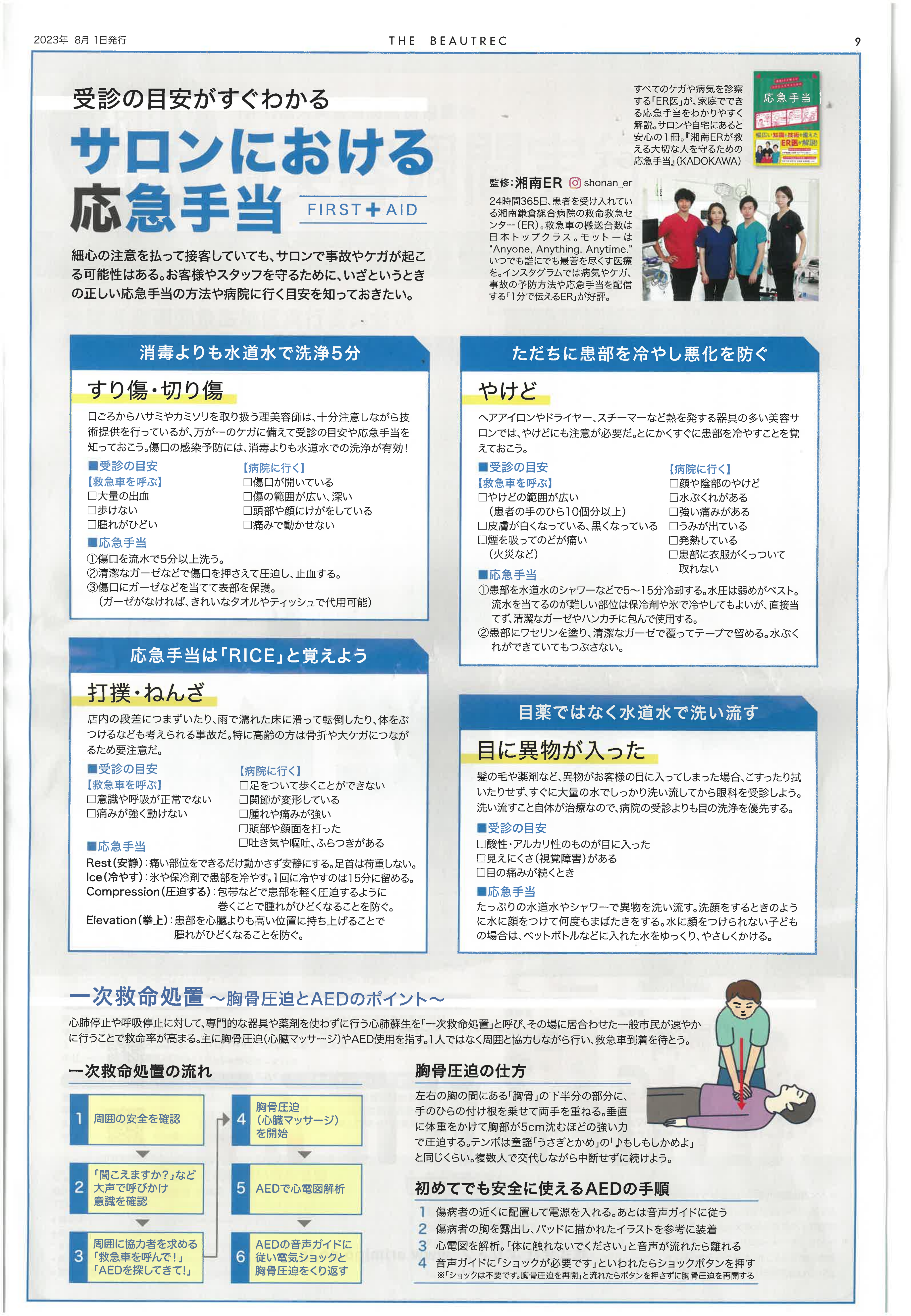
To quickly understand the general criteria for seeking medical attention
Emergency response in the salon: “FIRST + AID” (First Aid)
Even when providing services with the utmost care, accidents and emergencies can still occur in a salon. To protect the safety of both clients and staff, it is advisable to understand the correct first‑aid procedures for different situations, as well as the general criteria for determining when medical attention is necessary.
Supervised by: Shonan ER @shonan_er
“ER doctors who can recognize all kinds of emergencies and illnesses help you easily learn first‑aid methods you can use at home. This is a reassuring guide.
‘First Aid You Can Learn for Use in Salons and at Home to Protect the People Important to You’ (KADOKAWA)”
Instead of disinfecting, rinse the area under running water for 5 minutes.
Abrasions / Cuts
Our beauty clinic takes great care to provide treatments that remove the stings and hairs of Japanese oak silkworms and redback spiders, but in case of any unexpected situation, we recommend understanding the criteria for seeking medical attention and the appropriate first‑aid procedures.
To prevent wound infection, rinsing with running water is more effective than disinfecting.
General criteria for seeking medical attention
【Situations that require calling an ambulance】
Severe bleeding
Unable to walk
Suspected dislocation
【Situations that require visiting a hospital】
Wound opening / wound dehiscence
Large or deep wound
Head or facial injury
Unable to move due to pain
First‑aid treatment
①Rinse the wound under running water for at least 5 minutes.
②Apply pressure to the wound using a clean gauze or similar material to stop the bleeding.
③Cover the wound with a clean gauze to protect the injured area.
(If gauze is not available, a clean cloth can be used instead.)
Additionally, apply a cold compress to the affected area to prevent the condition from worsening.
In beauty salons where heating tools such as hair dryers, curling irons, and steamers are used, extra caution is especially needed.
Please be sure to remember to apply a cold compress to the affected area as soon as possible.
General criteria for seeking medical attention
【Circumstances in which you should call an ambulance】
When the burn or scald covers a large area (more than 10 times the size of the patient’s palm)
The skin appears white or black
Pain when breathing in (such as in cases of burns, etc.)
【Circumstances in which you should seek medical attention at a hospital】
facial or genital burns/scalds
Blisters appear
Severe pain
Pus is draining
Fever
Clothing stuck to the affected area and cannot be removed.
First aid treatment
①Cool the affected area with running tap water (such as a shower) for 5 to 15 minutes, using a weak water pressure. For areas that are difficult to run water over directly, you may also use coolant or ice packs, but do not apply them directly to the skin. Wrap them in a clean gauze or handkerchief first.
②Apply petroleum jelly to the affected area, cover it with a clean gauze pad, and secure it with tape. Do not pop any blisters, even if they form.
First aid can be remembered using the RICE principle.
For falls, sprains, and twists
Possible accidents include tripping on steps in the shop, slipping on a wet floor, or bumping into objects. Special care should be taken with elderly people, as they are more prone to fractures or injuries.
General criteria for seeking medical attention
【When to call an ambulance】
Abnormal consciousness or breathing.
Severe pain preventing movement.
【When to Go to the Hospital】
Unable to walk normally.
Joint deformity.
Severe swelling and intense pain.
Blow to the head or face.
Nausea, vomiting, or dizziness.
First Aid
Rest(安靜):Avoid moving the painful area and keep it at rest. If the foot is injured, do not bear weight on it.
Ice(冷敷):Apply cold compresses with ice or coolant. Limit each session to 15 minutes.
Compression(壓迫):Apply gentle compression with a bandage to help reduce swelling.
Elevation(舉高):Elevate the affected area above heart level to reduce swelling.
Do not apply medication. Rinse with running tap water.
Foreign object in the eye.
If a foreign object (such as hair or medication) enters the eye: do not rub it. Rinse immediately and continuously with plenty of clean water, then see an ophthalmologist. Prioritize rinsing, as it can often help the eye recover on its own.
General Criteria for Seeking Medical Attention
Acid or alkaline substance in the eye.
Blurred or impaired vision.
Persistent eye pain.
First Aid
Flush with plenty of running tap water or shower water. Submerge the face and blink repeatedly. If submersion is not possible, rinse with water from a small bottle while blinking gently.
First Aid Measures – Key Points of Chest Compressions and AED Use
When cardiac arrest or respiratory arrest occurs and professional equipment or medication is not immediately available, performing emergency measures such as cardiopulmonary resuscitation (CPR) allows ordinary bystanders to provide timely assistance, thereby increasing the chance of survival. CPR mainly consists of chest compressions and the use of an AED. If you are alone, call for help from people nearby while waiting for an ambulance to arrive.
First Aid Procedures
1、Ensure scene safety.
2、Check for responsiveness by shouting, “Are you okay?”
3、Shout for assistance: “Call 120!” “Get an AED!”
4、Begin chest compressions.
5、Analyze the rhythm with the AED.
6、Deliver a shock as instructed by the AED, then continue chest compressions.
How to perform chest compressions: Place the heel of one hand on the lower half of the breastbone (sternum), between the two nipples, and place the other hand on top. Press down vertically using your body weight, compressing the chest by about 5 cm. The rate should be similar to the rhythm of the children’s song “Little Rabbit, Be Good.” Have multiple people take turns to keep compressions going without interruption.
AED Steps for Safe Use (Even for First-Time Users):
1、Place the AED near the victim and turn it on, then follow the voice prompts.
2、Expose the victim’s chest and attach the pads according to the illustrations on the pads.
3、Allow the AED to analyze the heart rhythm. When prompted “Do not touch the patient,” everyone must stay clear of the victim.
4、If the voice prompt says “Shock advised,” press the shock button.
※ If no shock is needed, the AED will say “Continue CPR,” and you should immediately resume chest compressions.
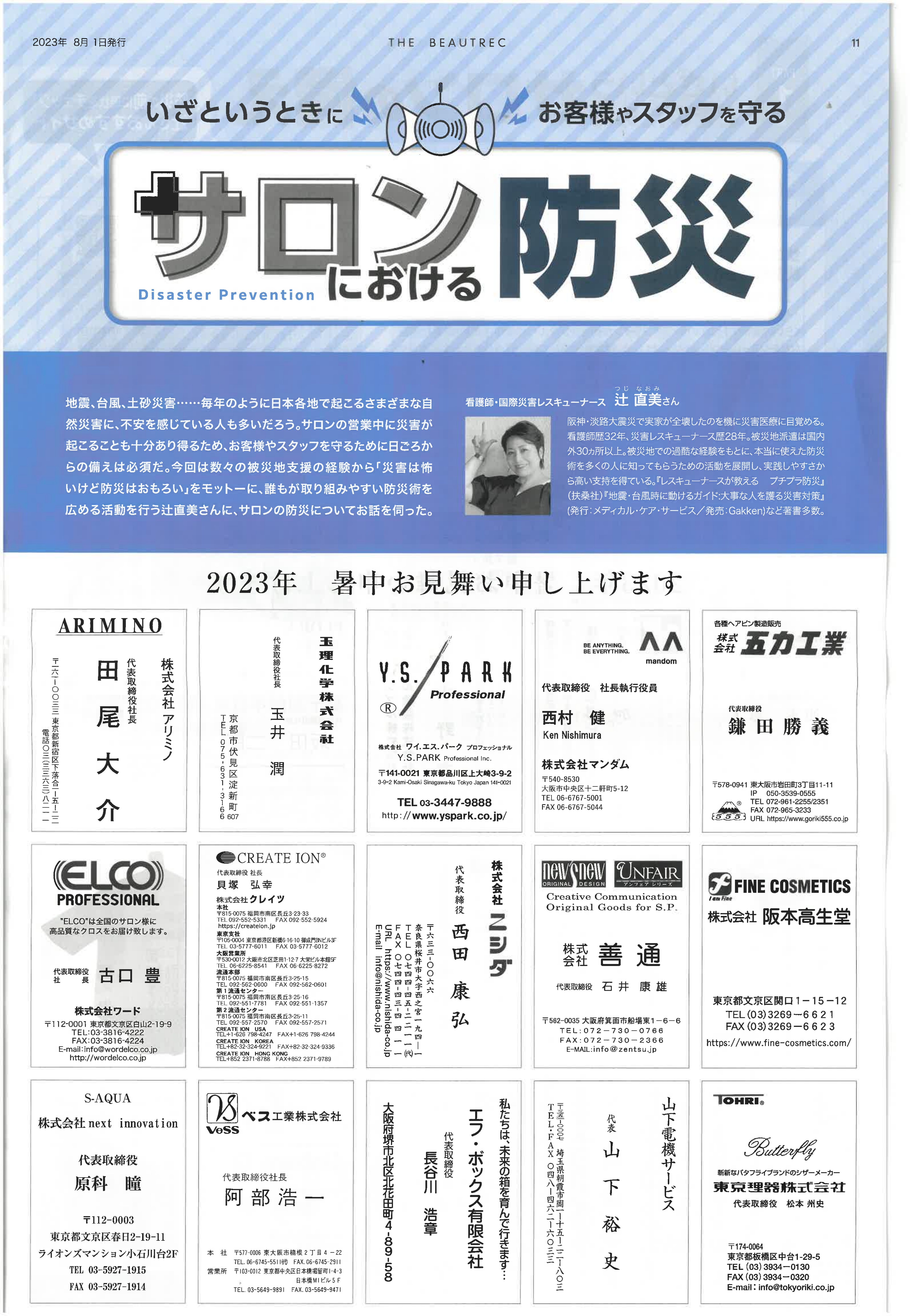
Protecting Customers and Staff During Emergencies
Store Disaster Preparedness
Disaster Prevention(防災)
Earthquakes, typhoons, landslides… Severe natural disasters occur frequently across Japan every year, making many people feel anxious. The possibility of a disaster happening while a store is open is not low, so daily preparedness is essential to protect both customers and staff. This time, we invited Ms. Senbi, who has extensive experience supporting disaster-affected areas and promotes easy-to-follow disaster prevention with the slogan ‘Disasters are scary, but disaster prevention can be fun,’ to discuss topics related to store disaster preparedness.
Ms. Naomi Tsuji – International Disaster Response Advisor & Instructor
After losing her home in the Great Hanshin-Awaji Earthquake, she resolved to dedicate herself to disaster preparedness. With 32 years of experience as a lecturer and 28 years as a disaster consultant, she has visited more than 30 disaster-affected areas in Japan and abroad. Drawing on her on-the-ground experience, she has mastered truly practical disaster prevention techniques. She also actively shares disaster preparedness knowledge through social media, earning strong support from the public. She is the author of numerous books, including Disaster Prevention Made Easy by a Disaster Consultant (Fusosha) and Key Disaster Measures for Earthquakes and Typhoons (Published by K.S. Service Co., Ltd. / Distributed by Gakken).
Warm mid-summer greetings for 2023.
...
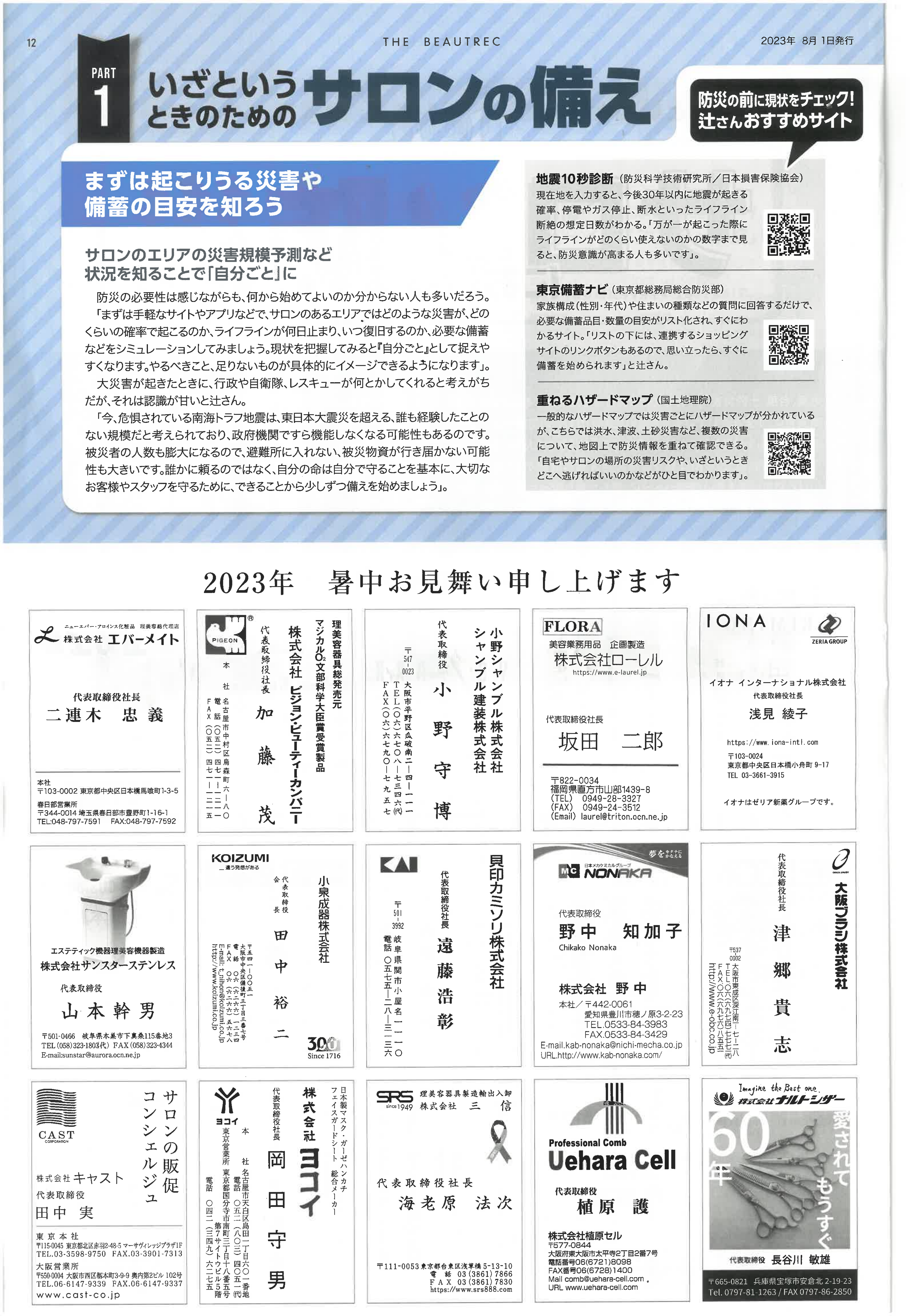
Page 12
Part 1 Preparing for Emergencies: Daily Store Readiness
Know potential disaster types and supply stockpile standards.
Understanding the local disaster risks is the first step in taking personal responsibility for disaster preparedness.
Although many people feel that disaster preparedness is necessary, they may not know where to start.
First, use easy-to-access websites or apps to simulate and understand the types of disasters that could occur in your store’s area, their likelihood, how long transportation might be disrupted, how long recovery may take, and what supplies you should stock. Once you have a clear picture of the situation, it becomes much easier to take concrete steps toward ‘helping yourself’ in a disaster and to identify what you need to do and what supplies you lack.
In the event of a major disaster, people often assume that government agencies, the Self-Defense Forces, or rescue teams will come to their aid. However, this is a dangerous misconception.
The anticipated Nankai Trough earthquake is a growing concern. It is expected to exceed the scale of the Great East Japan Earthquake, reaching an unprecedented level, and could even render some government functions inoperable. The number of victims would surge, making it highly likely that people may be unable to reach evacuation centers and that relief supplies may not arrive in time. Instead of relying on others, the fundamental principle is to ‘protect your own life.’ To safeguard your valued customers and staff, start preparing with small, manageable steps that you can take today.
Check Your Current Disaster Preparedness First! Super-Easy Websites to Use
Earthquake 10‑Second Diagnosis (National Research Institute for Earth Science and Disaster Resilience / General Insurance Association of Japan)
By entering your current address, you can see data such as the probability of an earthquake occurring in that area over the next 30 years, how long the shaking may last, how many days water, electricity, and transportation may be disrupted, and roughly how many days of supplies you should prepare. Many people have increased their disaster preparedness awareness through these insights.
Tokyo Stockpile Guide (Department of Comprehensive Disaster Prevention, Bureau of General Affairs, Tokyo Metropolitan Government)
By simply answering questions about your family composition (gender, age) and housing type, the tool generates a detailed checklist of necessary supplies, including recommended quantities. Even those who are not familiar with disaster preparedness can easily understand what to do through this simple Q&A format. According to the staff, ‘Many people start thinking about and preparing their stockpiles immediately after using this tool.
Disaster Prevention Map (GSI)
While typical disaster maps separate hazard maps from risk maps, this one overlays information on floods, tsunamis, volcanic eruptions, and earthquakes. It also allows you to check the disaster risks at your home or store, as well as where to evacuate in an emergency.
Warm mid-summer greetings for 2023.
...
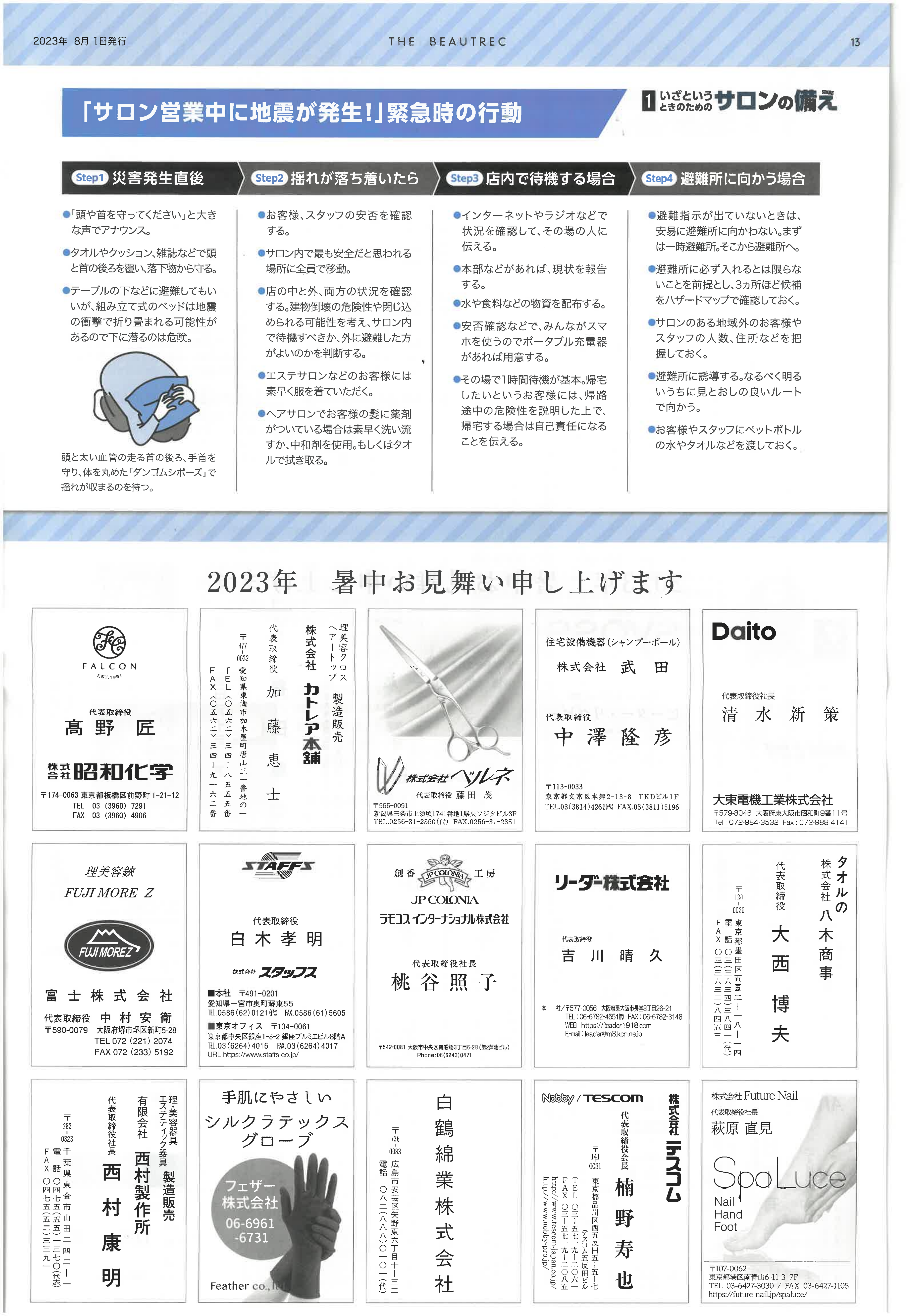
【An Earthquake Strikes While the Store Is Open!】Emergency Actions
What We Mean by ‘Everyday’: Daily Store Preparedness
Step 1: After the Disaster
Alert those around you by shouting loudly, ‘Protect your head and neck!
Cover the back of your head and neck with a towel, cushion, magazine, or similar item to protect yourself from falling objects.
You may be able to take shelter under a table, but freestanding tables can break or collapse due to the impact of an earthquake, so hiding underneath them can be dangerous.
Protect your head, the back of your neck where important blood vessels are located, and your arms. Curl your body into a ‘cushion position’ and wait until the shaking stops.
Step 2: Once the Shaking Has Stopped
Check on the safety of customers and staff.
Lead all personnel to the safest area within the store.
Assess conditions inside and outside the store. Consider the risk of building collapse and potential entrapment, then decide whether it is safer to stay inside or evacuate outdoors.
Promptly assist customers in the elevator to wear protective gear.
If a customer has chemicals on their hair, rinse it off as soon as possible, use a neutralizer if available, or wipe it clean with a towel.
Step 3: When Sheltering in Place Inside the Store
Use the internet, radio, or other sources to check the situation and inform everyone present.
Notify your headquarters or supervisory organization of the current situation without delay.
Allocate essential supplies, including drinking water and food.
As individuals may use mobile phones to verify safety, ensure that power banks and charging equipment are available.
In principle, everyone should wait at the scene. For customers who wish to return home, explain the dangers of traveling and inform them that they will be responsible for their own safety if they choose to leave.
Step 4: In the Event of Evacuation to a Shelter
Even after receiving an evacuation instruction, avoid proceeding directly to the shelter. Seek temporary refuge first, then make your way to the shelter.
Anticipating that the primary shelter may be unavailable, identify approximately three backup shelters beforehand with the help of a map.
Maintain records of the number of customers and employees residing outside the store’s district, along with their residential addresses and other pertinent details.
Lead all individuals to the shelter via a route with clear signage and easy visibility.
Provide customers and employees with portable items including water and towels.
Warm mid-summer greetings for 2023.
...
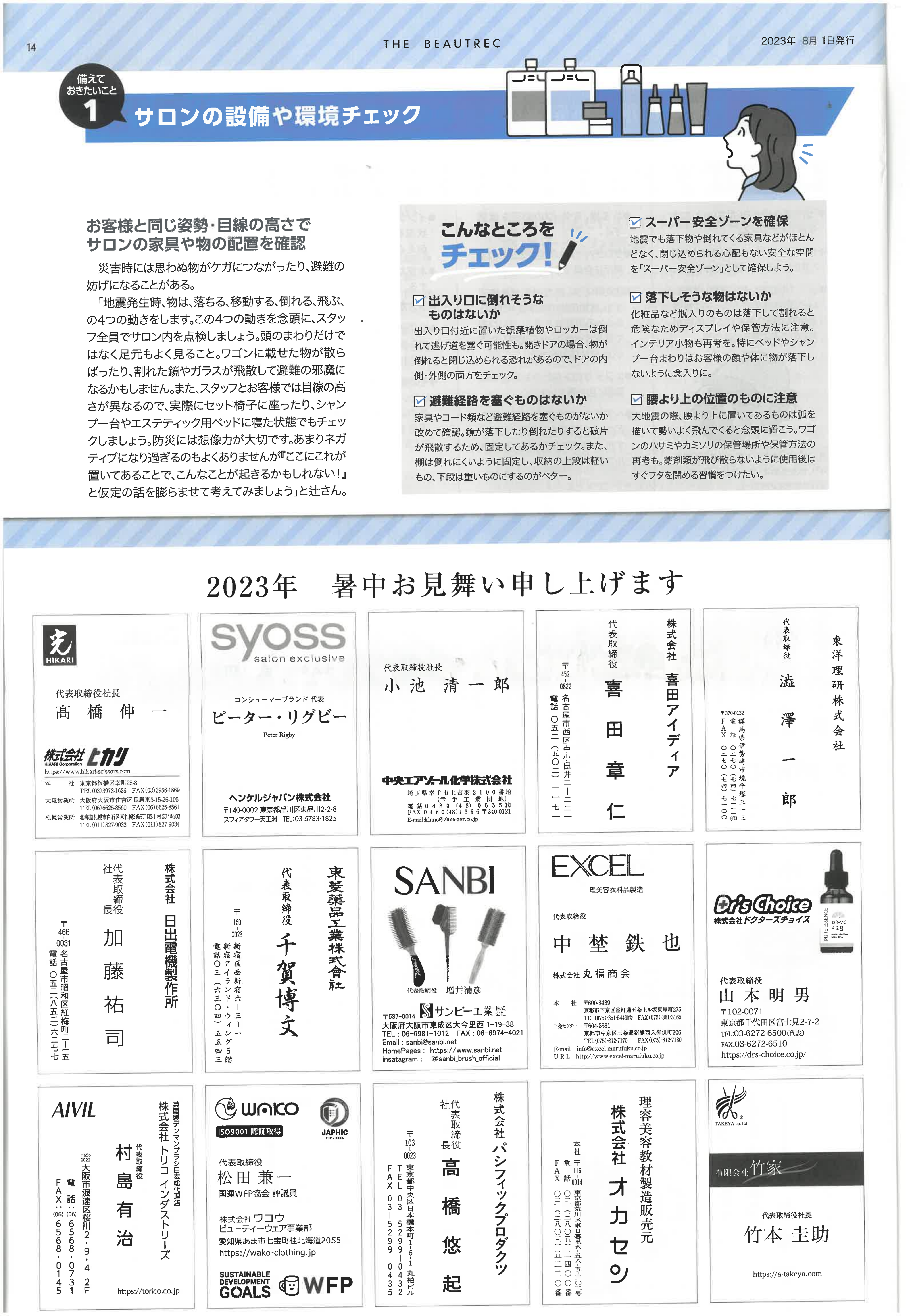
Page 14
Things to prepare in advance 1: Whistle preparation and environment check
Check the placement of whistle-related furniture and items from the same posture and eye level as the customer.
When a disaster occurs, items that you normally don’t pay attention to can suddenly become obstacles and hinder evacuation.
During an earthquake, objects can be in four states: falling, moving, tipping over, or scattering. All staff should keep these four states in mind and inspect the store together. Pay attention not only to what is above you, but also to what is underfoot. For example, items falling from shelves or shattered mirrors and glass can scatter and block evacuation routes.
In addition, staff and customers are at different eye levels, so it is recommended to actually sit in the chairs or crouch down to the height of sofas or elevator buttons when conducting inspections. Disaster prevention requires imagination, so don’t worry about being too cautious — try asking yourself, “If this object were here, what could happen?”
Try to imagine different scenarios and think through what could happen.
Be sure to check these spots!
Are there any objects near the entrances/exits that could tip over?
Large plants, storage cabinets, and other items placed near entrances or exits may tip over and block escape routes. For areas with doors, there is a risk that falling objects could block the door, so be sure to check both the inside and outside of the door.
Are there any objects that could block the evacuation route?
Check whether furniture, cables, or other items might block evacuation routes, and make corrections as soon as any issues are found. When mirrors fall or tip over, they can shatter and scatter fragments, so verify that they are securely fixed. In addition, make sure that shelves that could potentially topple are properly secured. When storing items, it’s a useful practice to place lighter objects on upper shelves and heavier items on lower shelves.
Ensure the super safe area is properly secured.
Let’s identify and secure what we call a “super safe zone” — a space where, even during an earthquake, there will almost never be falling objects and where you won’t be trapped by toppling furniture.
Be mindful of objects at waist height and above.
During a major earthquake, it is important to remember that objects located at waist height or above can fly straight toward you. Please reconsider the placement and storage methods of shelf partitions, storage boxes, and similar items. Also, make it a habit to tightly close the caps of all bottles after use to prevent chemicals from splattering.
Warm mid-summer greetings for 2023.
...
Page 15
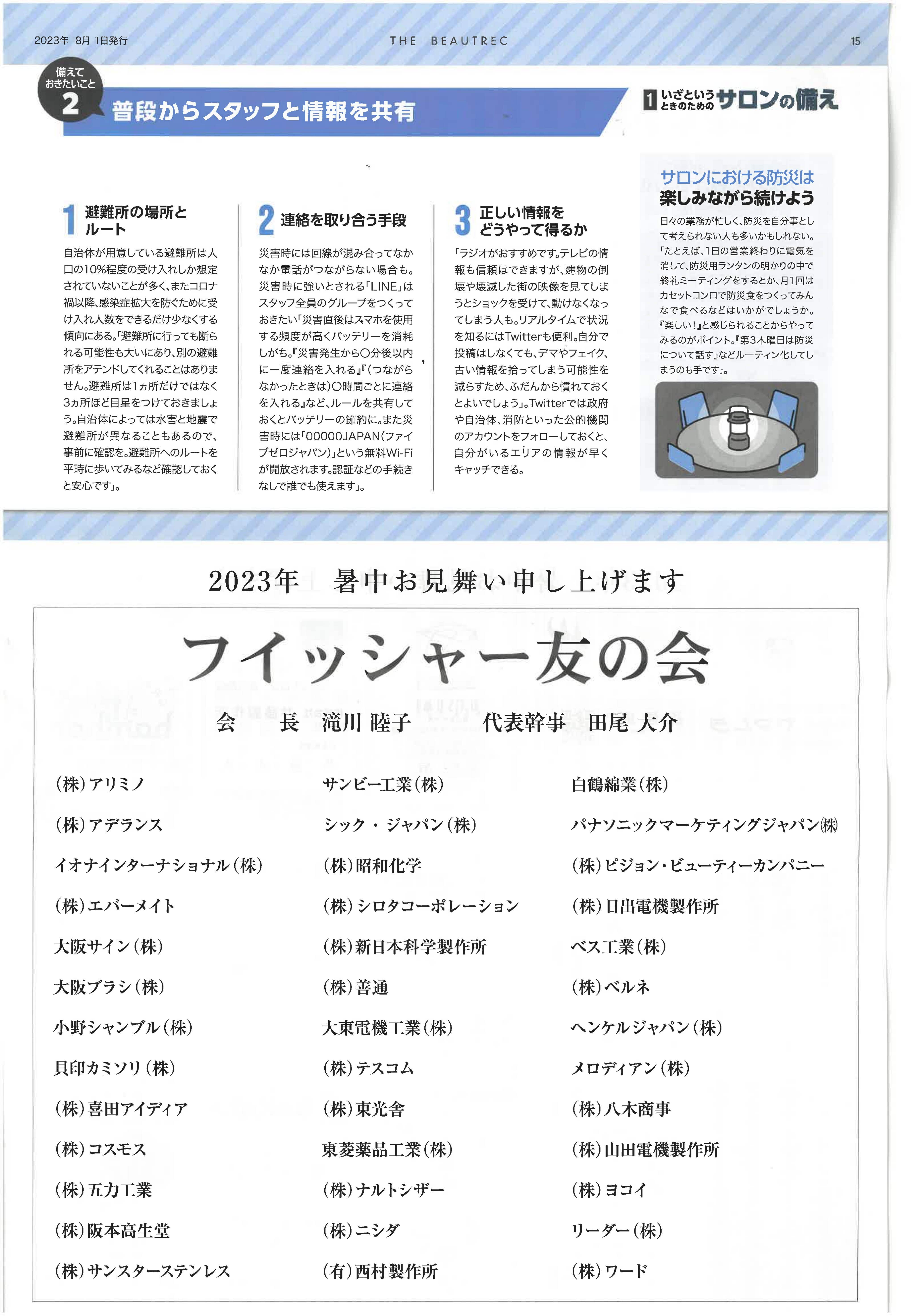
Things to prepare in advance 2: Daily sharing of supplies and information
1. Location of shelters and evacuation routes
In many cases, the shelters prepared by local governments are not designed to accommodate around 10% of the population. Moreover, since the COVID-19 pandemic, the number of people they can accept has tended to decrease to prevent the spread of infectious diseases. Even if you go to a shelter, you may be turned away, so it is advisable to prepare alternative shelters.
Do not rely on just one shelter; it is best to select about three in advance. In addition, the shelters designated for floods and earthquakes may differ depending on the local government, so this should also be confirmed beforehand. For added safety, it is recommended to actually walk the evacuation routes to the shelters during normal times.
2. Ways to contact each other
During a disaster, cell phone signals may be disrupted and calls may not get through. LINE is considered very useful in such situations, so it’s a good idea to create a group chat that includes all family members.
Right after a disaster occurs, message traffic is very high, which can quickly drain your battery. You could agree on a rule such as “Contact each other once within the set time after a disaster.” If that’s not possible, sharing a rule like “We’ll check in at the set time” can help save power.
In addition, during a disaster, a free Wi-Fi service called “00000 JAPAN (Free Service)” is made available. It can be used by anyone without the need for authentication or other procedures.
3. How to obtain accurate information
A radio is the most convenient tool. You can also rely on information from TV, but some people may be shocked and unable to act after seeing images of collapsed buildings or flooded streets.
Twitter is also useful for keeping up with the situation in real time. Even if you don’t post anything yourself, it’s a good idea to become familiar with how to use it to reduce the chance of seeing outdated information. By following accounts of the government, local authorities, fire departments, and other public organizations on Twitter, you can get information about your area more quickly.
Preparing a whistle just in case
Continue learning about whistle-related disaster prevention knowledge in an easy and relaxed way.
“During the day, work can be very busy, so many people don’t think of disaster preparedness as their own responsibility. For example, after closing the store for the day, you could turn off the power and hold a closing ceremony by the light of the emergency lights. Or once a month, you could use the gas stove to make disaster‑preparedness food and eat it together — why not try these simple ideas? The key is to start with things that feel ‘fun’ or engaging. Setting a theme day like ‘Disaster Prevention Wednesday’ to talk about safety topics each week is another great approach.”
Warm mid-summer greetings for 2023.
...
Page 16
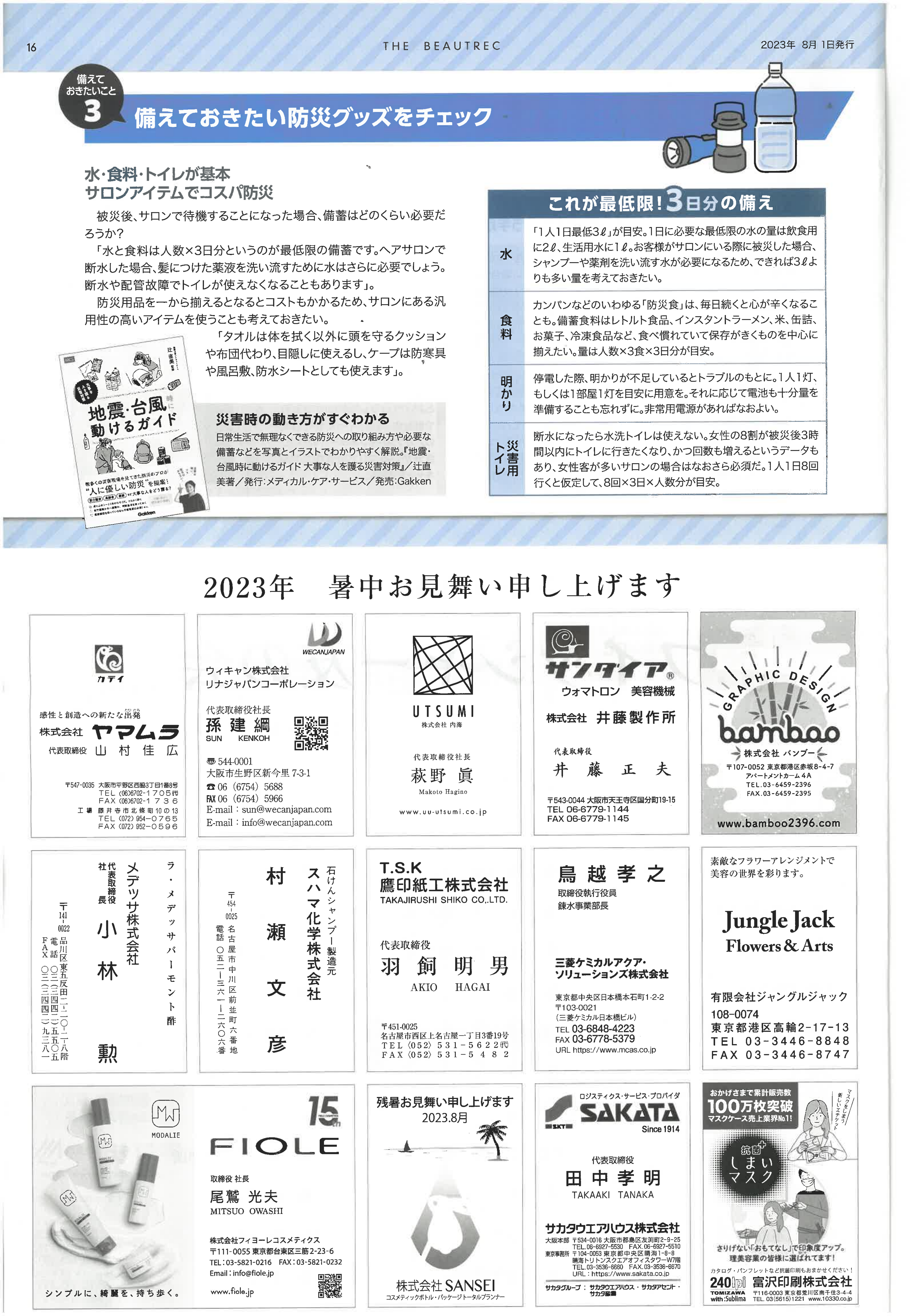
“Things to prepare in advance”3: Check the fire‑prevention items you need to get ready
Water, food, and a toilet are the basics. By practicing with these items, you can reduce the “cost” of fire prevention.
If a fire breaks out and you need to wait at an evacuation shelter, is it necessary to stock up on supplies? “You should prepare at least ‘number of people × 3 days’ worth of water and food. For example, if you use household propane gas, you’ll also need a lot of water to wash pots and dishes if the water supply stops. In addition, if there’s a water outage or a pipe failure, toilets may become unusable.”
If you try to choose from a long list of fire‑prevention items, the cost can be quite high, so I’m also considering using items that have proven useful in drills.
“Wet wipes can be used not only for cleaning your body, but also to protect your head, as a substitute for a cloth, or to cover your privacy. A plastic sheet can be used as cold‑protection, a windbreaker, or a waterproof mat.”
You can quickly learn how to act when a disaster occurs.
It uses photos and illustrations to explain in an easy-to-understand way fire prevention measures that can be seamlessly integrated into daily life, essential stockpiles, and related content.Action Guide for Earthquakes & Typhoons: Disaster Response When Crisis Strikes / Written by Naomi Tsují / Published by Media Care Service / Released by Gakken.
This is the minimum! A 3‑day supply | |
Water | “It’s safest to have at least 3 liters of water per person per day. The minimum daily amount is 2 liters for drinking and cooking, and 1 liter for daily use. If you have guests staying at an evacuation shelter during an emergency, they may need to rinse off or wash dishes, so it’s best to plan for more than 3 liters per person.” |
Food | Non‑perishable items like canned goods can be stored as disaster food without needing to be eaten every day. The recommended stock mainly includes portable foods, instant soups, rice, salt, sweets, frozen foods, and other items that fit your daily eating habits and are easy to preserve. The quantity should be based on ‘number of people × 3 meals × 3 days. |
Lighting | When the power goes out, poor lighting can be a real problem. It’s safest for each person to have one light, or for each room to have at least one light as an emergency backup. Don’t forget to prepare enough batteries as well. If you have an emergency power supply, that’s even better. |
Disaster‑preparedness toilet | After the water supply stops, flush toilets can no longer be used. Data shows that 80% of women need to use the toilet within three hours of evacuating, and the frequency of using the toilet increases. So if there are many female guests at the evacuation shelter, this is absolutely essential. Assuming each person uses the toilet eight times a day, it’s safest to stock up based on “8 uses × 3 days × number of people.” |
Warm mid-summer greetings for 2023.
...
Page 17
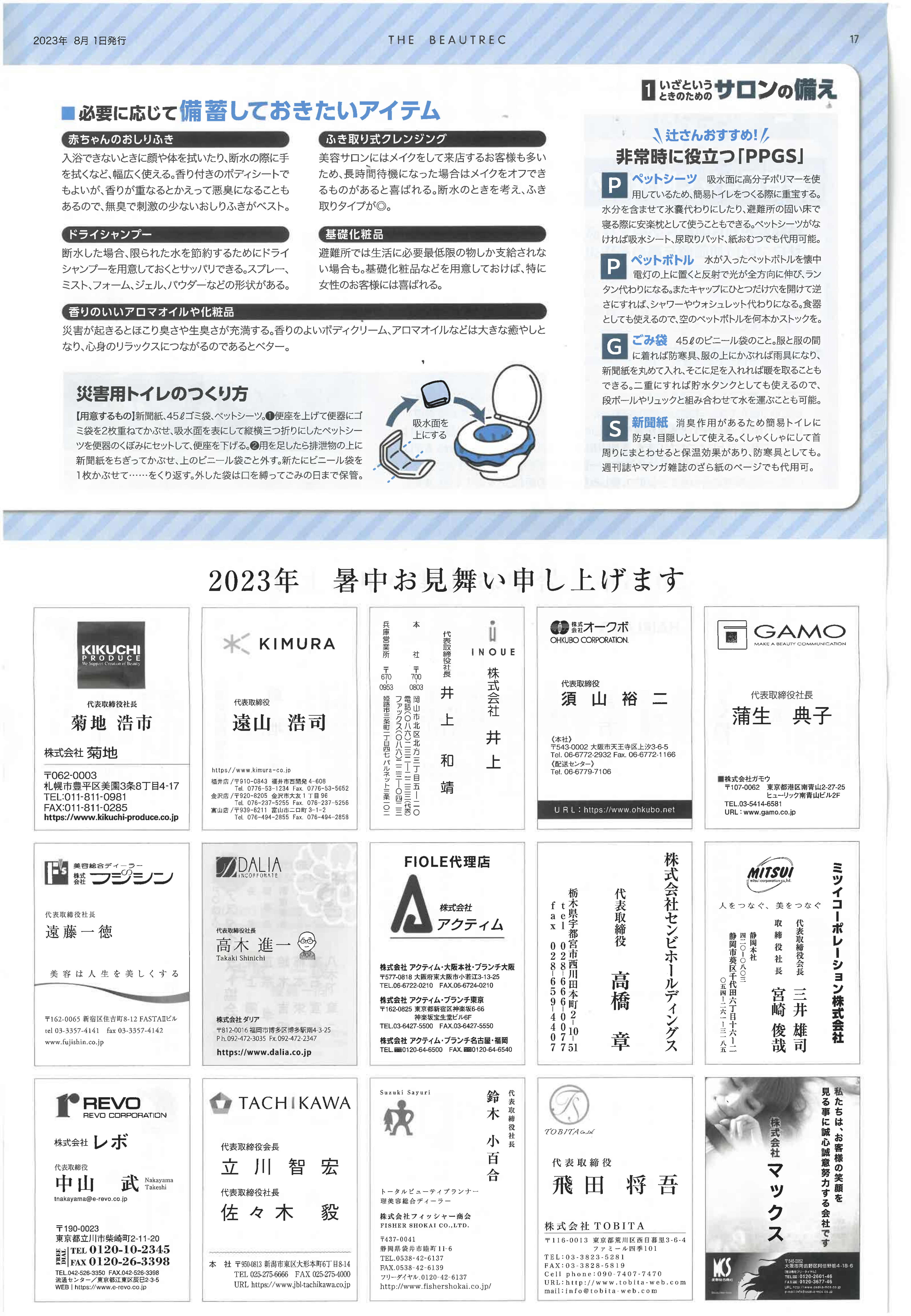
Recommended essential items to stock up on in advance
①Baby wipes
When you can’t take a bath, you can use them to wipe your face and body. They’re also useful for cleaning your hands when the water supply is cut off, so they have many purposes. Fragranced wipes are okay, but the scents can mix and create an unpleasant smell, so unscented, mild wipes are recommended.
②Cleansing wipes / wipe‑off makeup remover
In a beauty salon, many customers come in wearing makeup. If they need to wait for a long time, having something to help them remove their makeup will be very much appreciated. Considering the possibility of a water outage, wipe‑type (cleansing) products are more suitable.
③Dry shampoo spray
In the event of a water outage, it’s recommended to have dry shampoo spray on hand to conserve limited water. It comes in various forms such as spray, mist, foam, gel, and pump‑type dispensers.
④Basic cosmetics
In places like evacuation shelters, even the minimum daily necessities may not be fully available. If you prepare basic cosmetics in advance, they will be especially appreciated by female customers.
⑤Scented body oil and cosmetics
During a disaster, the surroundings are often filled with unpleasant or even putrid odors. Scented body lotions and body oils not only provide great comfort but also help relax the mind and body, so they are highly recommended.
How to set up a disaster toilet
【Items needed】 Newspaper, string about 45 cm wide, garbage bags.
① Lift the toilet seat and place two layers of garbage bags over the toilet bowl. Fold newspaper into thirds both lengthwise and widthwise (i.e., fold it multiple times), place it over the rim of the bowl, then lower the seat.
② After use, cover the waste with the newspaper and put on another new garbage bag. Then place another layer of newspaper on top… Repeat this process. Finally, tie the outer bag tightly and keep it until garbage collection day.
What is a “drill,” and why do we need to prepare for it?
Super simple!
The “PPGS” you’ll use in an emergency
P: Paper towels Thanks to their water‑absorbent polymer foam, they’re very useful when setting up a simple toilet. When dry, they can replace a water bladder, and they even work as a reassuring pillow when sleeping on a group bed in an evacuation shelter. If you don’t have these paper towels, you can substitute them with absorbent pads, incontinence pads, or regular tissue paper.
P: Plastic bottles Place a water‑filled plastic bottle under an emergency light, and the reflected light will spread in all directions, acting like a lantern. You can also cut off the bottom of a plastic bottle and invert it to use as a makeshift shower or faucet. It can even serve as tableware, so be sure to keep some empty plastic bottles on hand.
G: Garbage bags Use 45‑liter garbage bags. Worn between layers of clothing, they work as cold‑protection gear; worn over your clothes, they can act as rain gear. Stuff them with newspaper and put your feet inside to keep warm. Used in two layers, they can serve as a waterproof bucket, and when combined with rope or cord, they can even be used to carry water.
S: Newspaper Newspaper helps absorb odors, so it’s great for deodorizing and covering waste in a simple toilet. Crumple it up and wrap it around your neck for insulation—it can also be used as cold‑protection. Thick paper like weekly magazines or manga magazines can be used as substitutes.
Warm mid-summer greetings for 2023.
...
Page 18
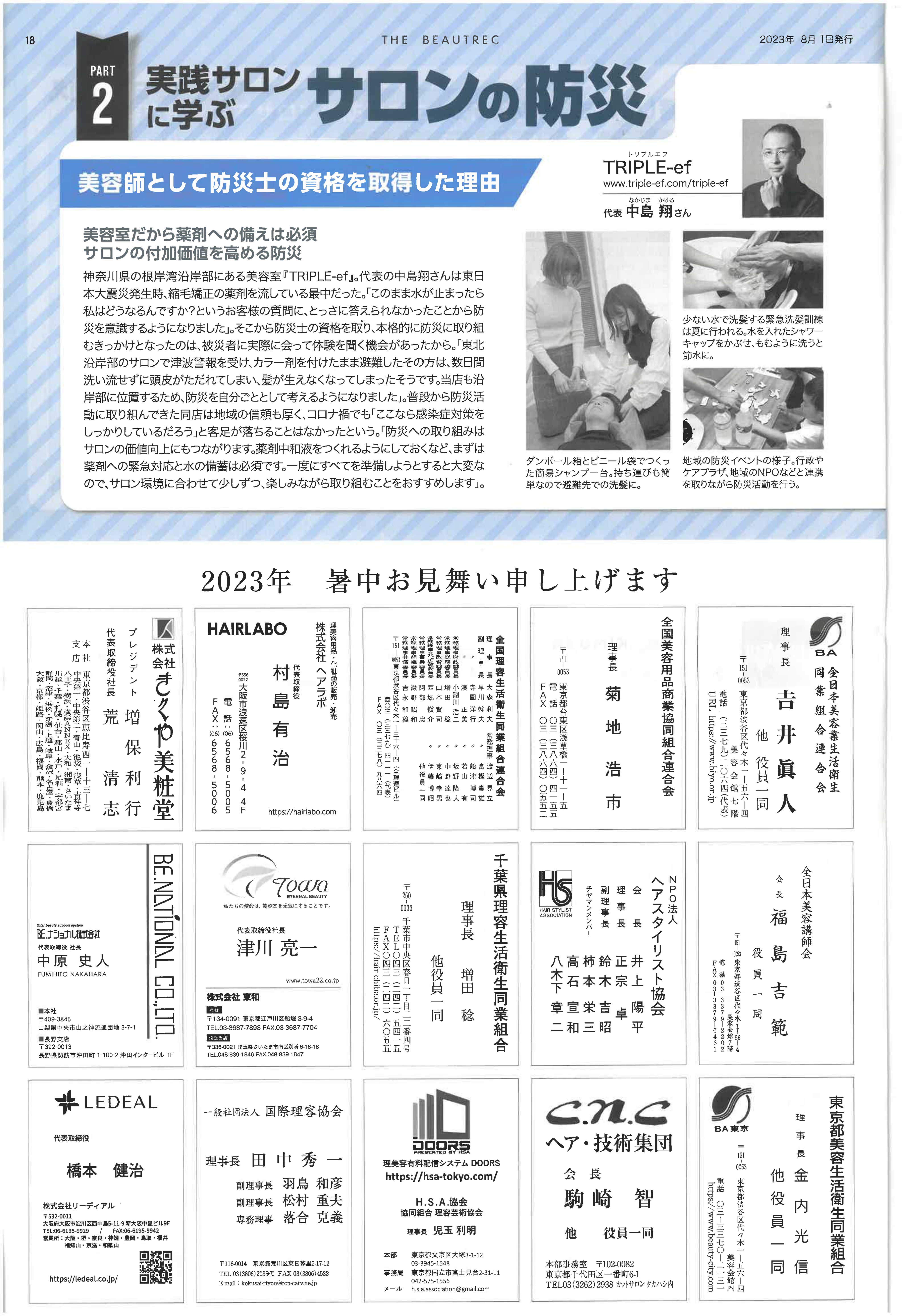
Part 2: Learning from Practical Fire Drills — Fire Prevention Knowledge for Fire Drills
Reasons why beauty professionals should obtain a fire safety certification
Beauty salons must also be equipped with a first-aid kit — Fire prevention measures that add value to fire drills
Shota Nakajima, representative of the beauty salon “TRIPLE-ef” in the coastal area of Negishi Bay, Kanagawa Prefecture, was in the middle of performing a hair straightening treatment using chemicals on a client when the Great East Japan Earthquake occurred.
When his client asked, “What should I do if the water stops now?” he couldn’t answer at the time — and that experience made him start taking fire safety seriously.
The turning point that motivated him to obtain a fire safety certification and become truly committed to fire prevention work was meeting disaster survivors and hearing their stories.
“During the Great East Japan Earthquake, I was in the coastal area of Negishi Bay when the evacuation alert was issued, and I had to flee the scene while still holding chemicals. At that time, I was assigned to help at a temporary shower station. Seeing firefighters risking their lives to carry out rescues, and being located along the coast of Negishi Bay myself, made me start thinking more actively about fire prevention.
I also realized that if we don’t conduct regular fire‑prevention activities, even if we’ve built up trust within the same shop area, customers won’t feel safe enough to say, ‘We even do infection‑control measures here.’”
“Promoting fire prevention can also increase the value of the salon. For example, to properly handle chemical neutralizers, you first need to prepare a first‑aid kit, emergency supplies, and water storage facilities. It can be difficult to get everything ready at once, so I start with small steps that fit the shop’s environment and move forward in a relaxed, manageable way.”
TRIPLE-e.f
Representative: Mr. Shota Nakajima
①Secure garbage bags and empty bottles with zip ties.Just give them a gentle twist to seal. Even heavy garbage can be easily fastened in place.
②Emergency rinsing drill using a small amount of water, conducted in summer.Place a towel in a bucket of water. Even if the bucket tips over, practice rinsing as quickly as possible.
③Local disaster‑prevention and environmental groups, children, government agencies, and local businesses work together to carry out fire‑prevention activities.
Warm mid-summer greetings for 2023.
...
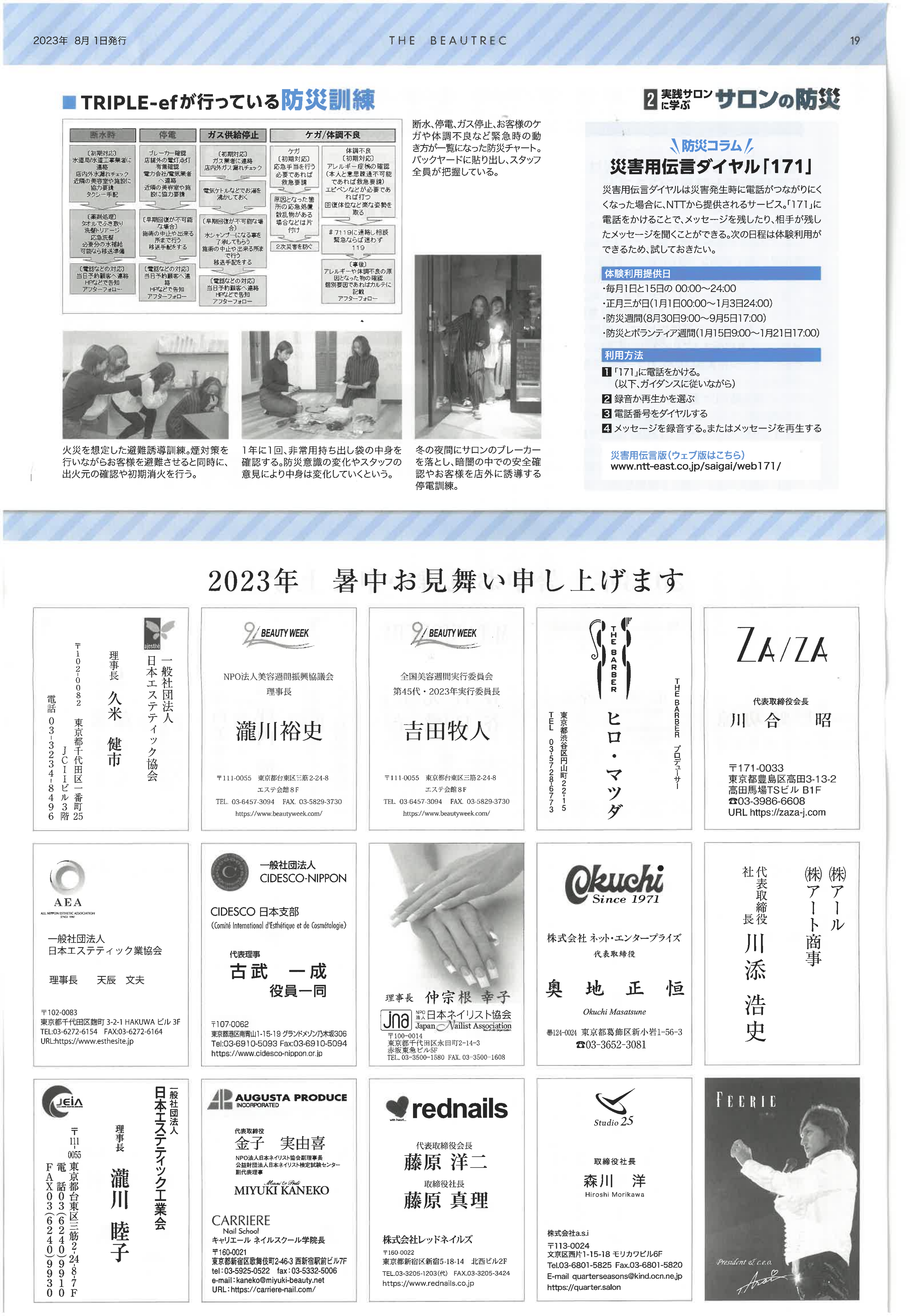
Page 19
Water outage | Power outage | Gas outage | Dizziness or feeling unwell | |
【initial response】 ①contact the Waterworks Bureau / ontact a waterworks contractor; ②Check for water leaks in the indoor and outdoor water pipes of the store; ③Request assistance from nearby facilities such as beauty salons.; ④Arrange for a water tank. | ①Check the power switch; ②Turn on the warning lights outside the store and check their status.; ③Contact the power company / Contact an electrical contractor; ④Request assistance from nearby facilities such as beauty salons. | 【initial response】 Contact the gas company. Check for gas leaks inside and outside the store. | dizziness 【initial response】Administer first aid;Call for emergency services if necessary. | feeling unwell 【initial response】 ①Check if the symptoms are due to an allergic reaction.(If the person is unable to communicate, call for emergency services.); ②If necessary, use an epinephrine auto-injector or other first-aid devices.; ③Place the person in the recovery position and ensure they are in a comfortable and stable posture. |
【follow-up measures】①Collect water using water storage buckets.; ②Hair washing and treatment → emergency hair washing; ③Provide the required amount of water.; ④Prepare for potential relocation. | 【If early recovery is not possible】 ①Stop the service (or finish the current step if possible).; ②Arrange for the customer to be transferred. | Please bring the soup in the steam pot and other utensils to a full boil. | Emergency response at the location where the incident occurred.If there are scattered items or debris, clean them up immediately. | Contact #7119 to coordinate.If the situation is urgent, call 119 directly. |
【Communication and response with customers】 ①Contact customers with appointments for the day. ②Inform customers of the situation via the website (HP) and other channels. ③Follow‑up | 【Customer communication and response】 ①Contact customers with appointments for the day. ②Inform customers of the situation via the website (HP) and other channels. ③Follow-up actions | 【If early recovery is not possible】 ①Please notify all personnel that we will transition to water spray firefighting.; ②Cease operations and withdraw to a safe location.; ③Arrange for evacuation/transfer. | Prevent secondary disasters. | 【After the incident】 ①Identify the product or substance that caused the allergic reaction or physical discomfort.; ②If the cause is identified as an individual trigger, document it in the medical record.; ③Conduct post‑incident follow‑up. |
【Customer communication and response】 ①Contact customers with appointments for the day.; ②Please inform customers of the situation via the website (HP) and other channels.; ③Follow-up actions | ||||
Disaster prevention training conducted by TRIPLE‑ef.
Response protocols for emergencies including water/electricity/gas supply interruptions and customer physical distress have been organized into an “Emergency Response Table,” and all personnel have been fully briefed and trained.
①Fire evacuation drill scenario: First implement smoke protection measures, then guide customers to evacuate, while identifying the fire’s point of origin and carrying out initial fire extinguishing.
②The emergency backpack contents are inspected annually, and adjustments are made according to evolving disaster preparedness awareness and input from staff members.
③A nighttime winter blackout drill simulating a power outage in the salon. Staff verify safety conditions in the dark and direct customers to exit the premises.
Learning salon disaster preparedness through practical case studies.
Disaster Prevention Course
Disaster Emergency Message Dial 171
The disaster information service “171” is provided by NTT for use when regular phone lines are difficult to connect during a disaster. By dialing “171,” you can leave a message and also listen to messages left by others. Since it can be used the next day, it is recommended that you try it out.
Provide a trial usage day.
l 每月 1 日和 15 日的 00:00~24:00
l 正月三日(1 月 1 日 00:00~1 月 3 日 24:00)
l 防災周(8 月 30 日 9:00~9 月 5 日 17:00)
l 防災與韌性周(1 月 15 日 9:00~1 月 21 日 17:00)
Usage instructions
①Dial “171”. (Please follow the voice prompts below.)
②Select the “record” or “playback” function.
③Enter the phone number.
④Record a message or play back a message.
Disaster Voice Message Service (for the web version, please click here).
www.ntt-east.co.jp/saigai/web171/
Warm mid-summer greetings for 2023.
...
Page 20
Promoting the salon’s disaster preparedness handbook through beauty support activities
Disaster preparedness essential for the beauty industry, and protecting customers’ hair and scalp
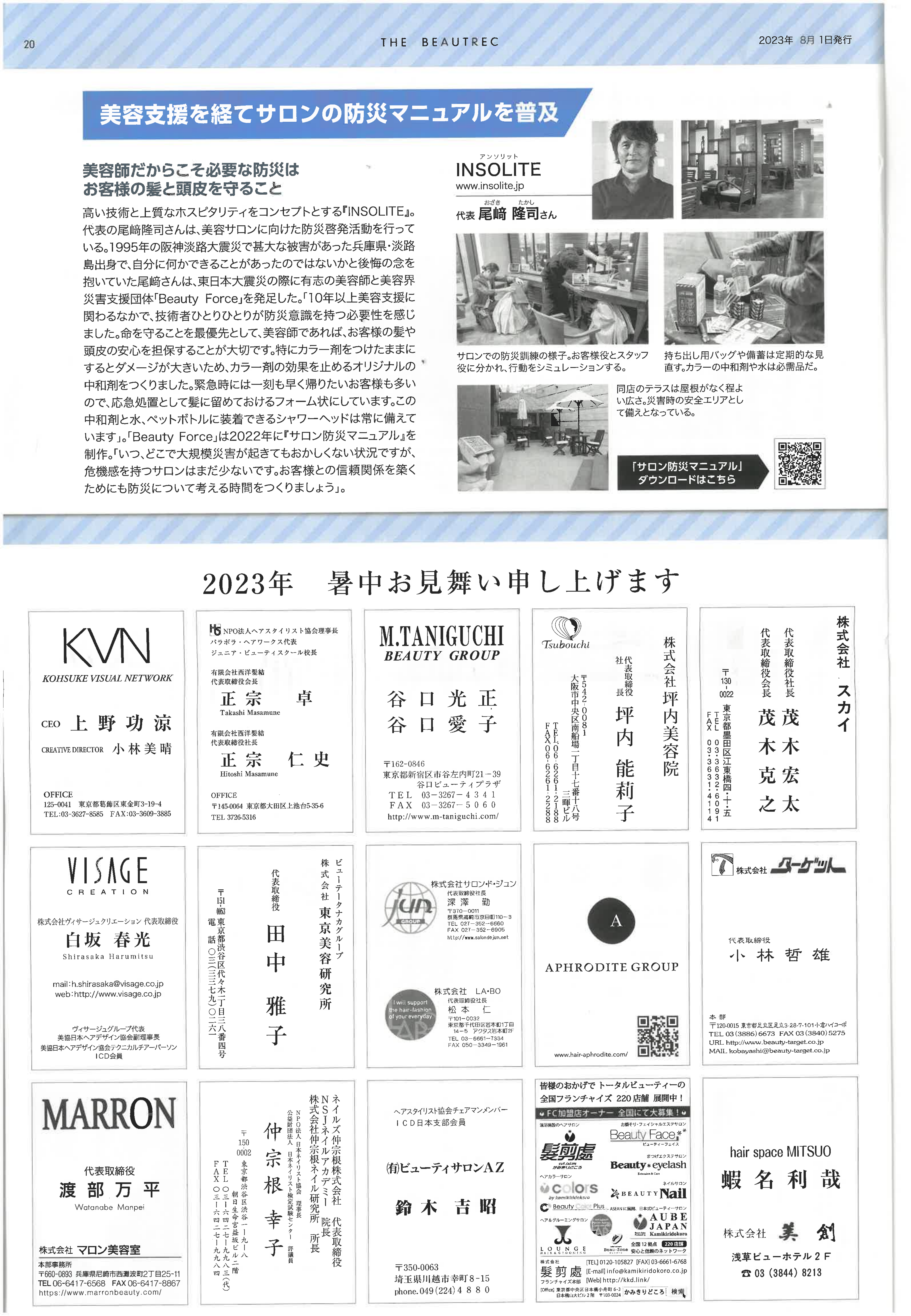
INSOLITE, a salon that prides itself on advanced techniques and exceptional customer service, is led by Takashi Ozaki, who is actively developing disaster preparedness initiatives for beauty salons.Ozaki was born on Awaji Island in Hyogo Prefecture, an area severely affected by the 1995 Great Hanshin-Awaji Earthquake. He has spoken openly about the regret he felt at being “unable to do anything” at the time.When the Great East Japan Earthquake struck, he joined forces with like‑minded beauty professionals to establish Beauty Force, a disaster support group within the beauty industry.“Having been involved in beauty support for more than 10 years, I’ve come to realize that disaster preparedness is essential for technicians. First and foremost, we must protect lives. But as beauty professionals, safeguarding our customers’ hair and scalp is also crucial.For example, right after a perm, the chemicals are still very active, so we’ve created our own original neutralizer that can counteract the effects of the perm solution. In an emergency, many customers want to return home as quickly as possible, so we provide emergency treatment and let them leave with a natural, makeup‑free appearance.This neutralizer, along with water and a PET bottle, can be attached to a showerhead and kept on hand for daily use.”In 2022, Beauty Force produced the Salon Disaster Preparedness Handbook.“Large‑scale disasters could happen at any moment, yet very few salons have a sense of crisis. To maintain the trust of our customers, it’s time we set aside time to think about disaster preparedness.”
INSOLITE(www.insolite.jp)
Representative: Takashi Ozaki
①Salon Disaster Preparedness Drill Example: A drill conducted jointly by customers and staff.
②Regularly inspect the contents of emergency backpacks — perm neutralizer and water are essential items.
③They share the rooftop with the neighboring shop, creating a safe space for use in the event of a disaster and allowing them to operate with peace of mind.
「Salon Disaster Preparedness Handbook — Download Here」
Warm mid-summer greetings for 2023.
...
Page 21
Experiencing a major earthquake in Kumamoto, my nostalgic hometown
After volunteering in the wake of the Kumamoto Earthquake, I realized how important the spirit of “supporting each other in times of crisis” truly is.
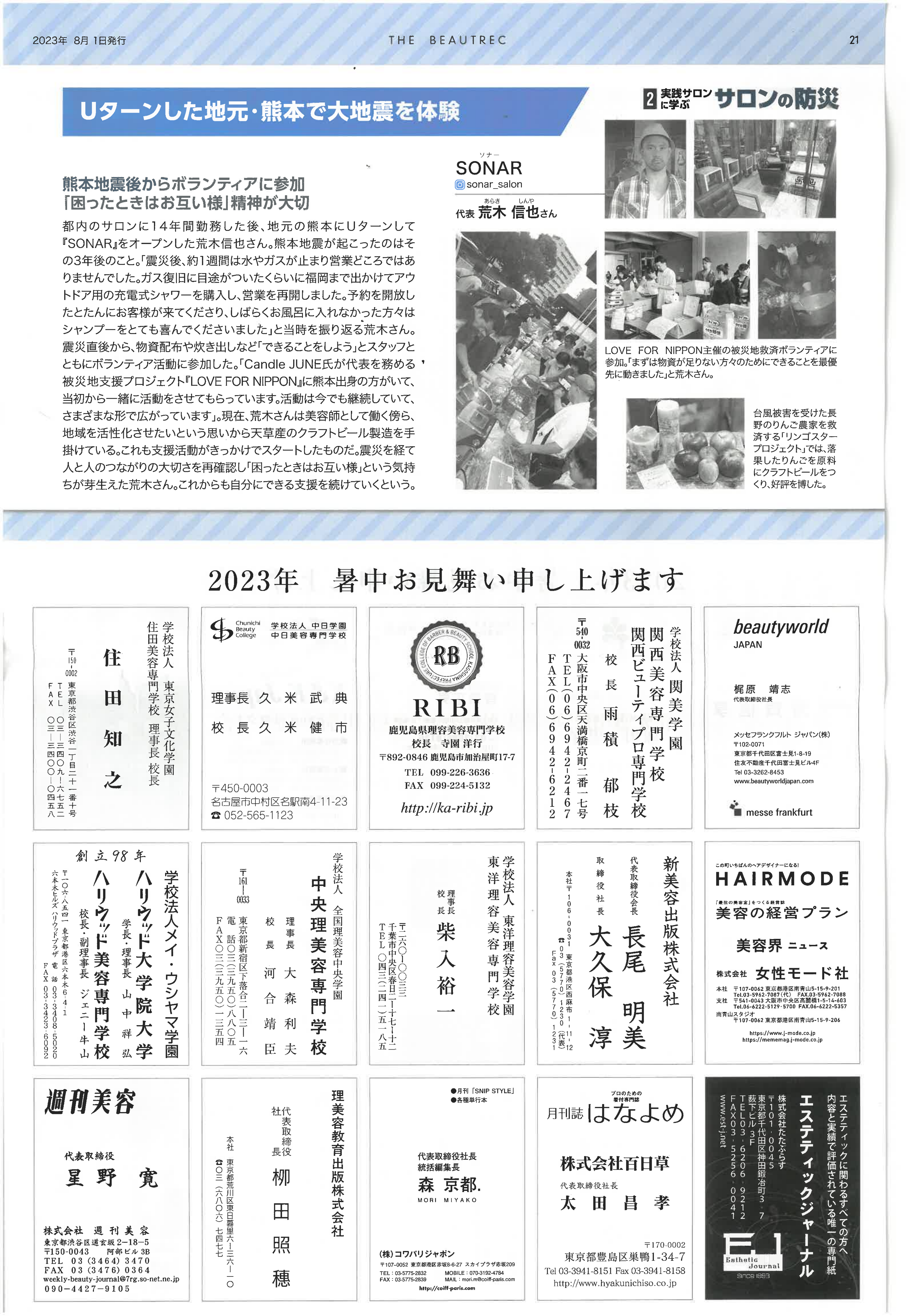
After working at a salon in Tokyo for 14 years, Shinya Araki returned to his hometown of Kumamoto and opened “SONAR.” The Kumamoto Earthquake struck three years after he went back.
“For about a week after the earthquake, there was no water or gas, so we couldn’t operate at all. To reopen as soon as possible, I even went all the way to Fukuoka to buy a rechargeable outdoor shower unit and got the salon running again,” Araki recalls.
“I just hoped that some customers would come once we reopened our booking system. But even though they couldn’t take a bath, people were happy just to be able to use the shower.”
Right after the earthquake, he volunteered in supplies delivery, meal preparation, and other efforts under the motto of “doing what I can.”
“I, as a Kumamoto local, have been participating in ‘LOVE FOR NIPPON’ — a disaster-stricken area support project led by Mr. Candle JUNE — since its inception, and we have been carrying out activities together all along. Today, the project is still ongoing, with increasingly diverse forms of initiatives.”
Today, while continuing to work as a beautician, Araki has also started producing brown sugar black tea from Amakusa with the aim of revitalizing the local community. This new venture grew directly out of his support activities.
Araki says that through his experience of the earthquake, he truly felt the importance of human connections and developed a strong belief in “supporting each other in times of trouble.” He adds that he will continue to offer whatever help he can in the future.
Learning Salon Disaster Preparedness Through Practical Experience
SONAR (Note: “Sonaa” is the Japanese pronunciation of “SONAR”)
Social Media: @sonar_salon
Representative: Shinya Araki
①Mr. Araki says, “I participated in disaster relief volunteer activities organized by LOVE FOR NIPPON. At that time, the first thing I did was what I could — helping people who were short of supplies.”
②In the “Kiwi Rescue Project,” which aimed to support kiwi farmers in Nagano affected by typhoon damage, kiwi tea made from fallen fruit was created and became very popular.
Warm mid-summer greetings for 2023.
...
Page 22
From the Great East Japan Earthquake Experience to the Path of Risk Design
Contributing to my hometown of Fukushima through the nursing care business
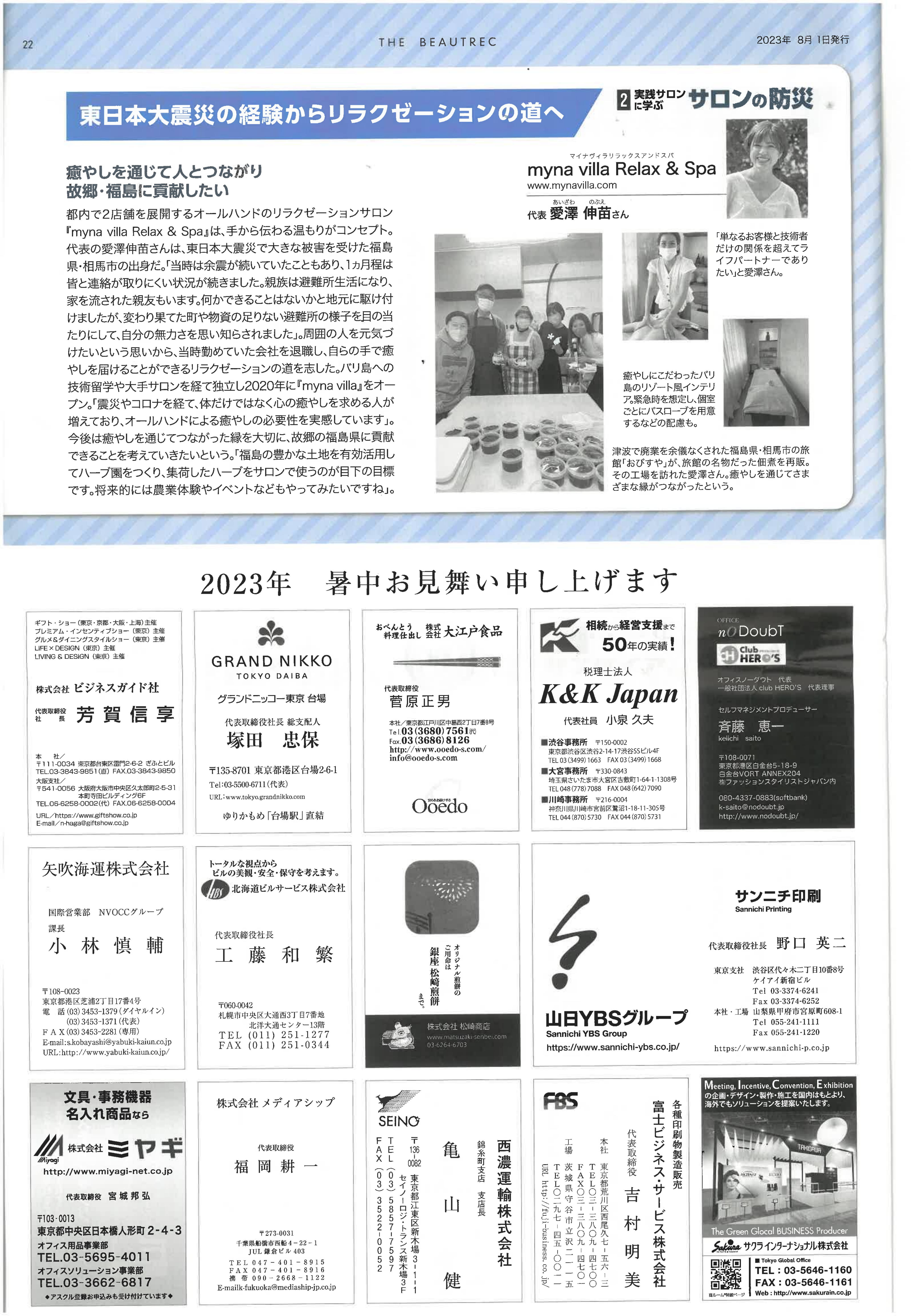
“myna villa Relax & Spa” is an original handmade esthetics salon with two locations in Tokyo, offering treatments focused on the “warmth passed from hand to hand.”
The owner, Nobena Aizawa, was born in Soma City, Fukushima Prefecture, an area severely affected by the Great East Japan Earthquake.
She says, “At the time, everything was chaotic, and for about a month, no one could get in touch with each other. My relatives were living in evacuation shelters, and some friends lost their homes to the tsunami. When I returned to my hometown, there was nothing I could do. I didn’t even have enough food or clothing for myself, let alone supplies to give to others. I felt truly powerless.”
It was with the desire to “help lift the spirits of the people around me” that she quit her job at the time and decided to pursue a career in esthetics, where she could provide healing with her own hands.
She later studied techniques in Okinawa, gained experience working at large-scale events, and eventually became independent, opening “myna villa” in 2020.
After experiencing the earthquake and the COVID-19 pandemic, more and more people are seeking not just physical healing — I have also truly felt the necessity of original handmade healing treatments.
Original Handmade Esthetics Salon myna villa Relax & Spa(www.mynavilla.com)
①Ms. Aizawa said, “We want to move beyond a relationship where the customer and the technician are simply one‑on‑one.”
②In the resort-style facility in Okinawa, once a place of healing, considerations have also been made for emergencies, such as preparing first-aid kits in each private room.
③In Soma City, Fukushima Prefecture, the inn “Obizuya,” which was abandoned due to the tsunami, has been revived under its original name as a producer of tsukudani (traditional simmered side dishes). It was in front of this tsukudani factory that Ms. Aizawa expressed her hope to continue this flavor through her healing‑focused business.
Warm mid-summer greetings for 2023.
...



AHMA Hair Council 3/F, CNT Commercial Building 302 Queen's Road Central, Hong Kong

info@ahmahaircouncil.com

+852 2557 2449


